A Poet's Double Life

For poets working outside the literary world.


7 Comments

Year in Review 2015


2016-new-year-ss-1920

This year was truly a double-life year. The first half of the year focused on getting the chapbook out into the world. The second half of the year focused on getting a new job and moving to Massachusetts. One realization: big changes in one side of the double life means the other side has to take a backseat. Once the job opportunity showed up, I got busy with preparing my applications and for two interviews as well as saying a very long goodbye to the city of Durham. Admittedly, I started the year in a bit of a writing funk. Fortunately, the weekly poetry dates with Kelly and the monthly poetry book club buoyed the poetry career while I focused on landing that job. This year’s highlights reveal how I was able to keep my toes in the poetry world.

January: Celebrated Living Poetry‘s 6th anniversary party.

February: Wrote poems for 14 Words of Love.

March: Appointed to Durham’s Public Art Committee.

April: Wrote 30 poems for the April 2015 Poem-a-Day Challenge. Organized poets writing at a Science talk and wrote a poem about the Hubble Telescope at the NC Museum of Natural Sciences.

May: Made the final revisions for the chapbook.

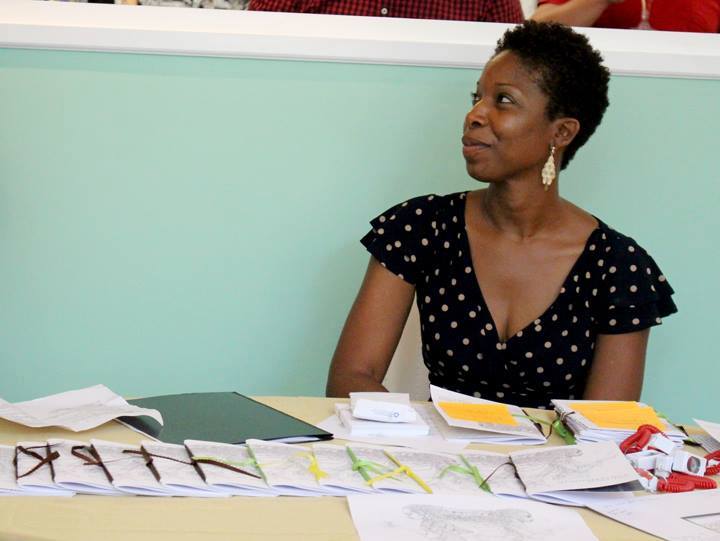
June: Chapbook launch and party for My Mother’s Child published by Hyacinth Girl Press.

July: Attended VONA retreat in Miami for writers of color and made so many more wonderful writer friends. Organized a second event and wrote a poem for King Pluto at the Science Talk on at the NC Museum of Natural Sciences. Took the Five-Day Poetry Challenge.

August: Not much writing but I did attend the poetry book club for Charles Wright. Read a poem at the 2015 Gospel Expo fundraiser for Johnson C. Smith University.

September: Read at Two Writers Walk Into a Bar one year after attending the event for the first time. Interviewed by Scott Fynboe for the SAFTACast.

October: Attended the West End Poetry Festival.

November: Started sorting and organizing my books for the big move!

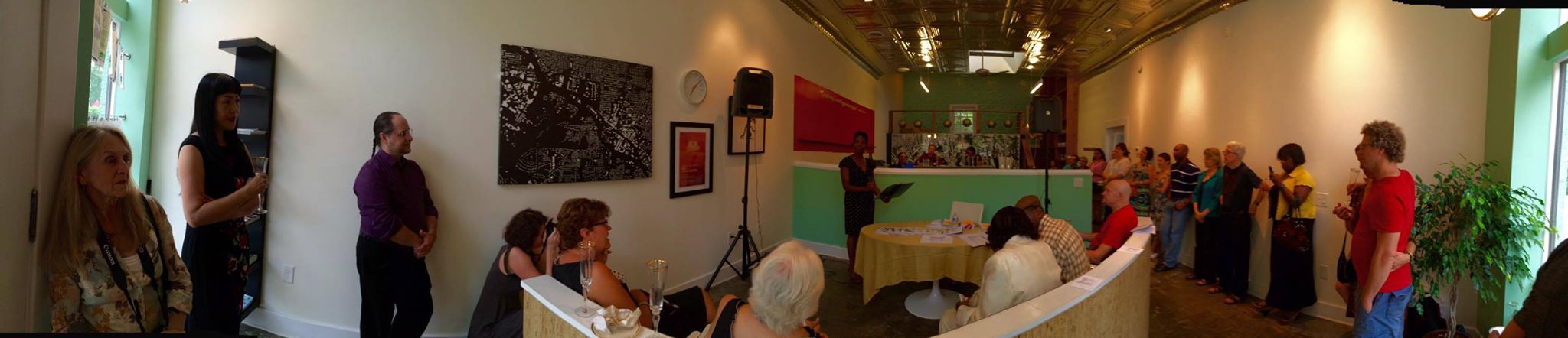
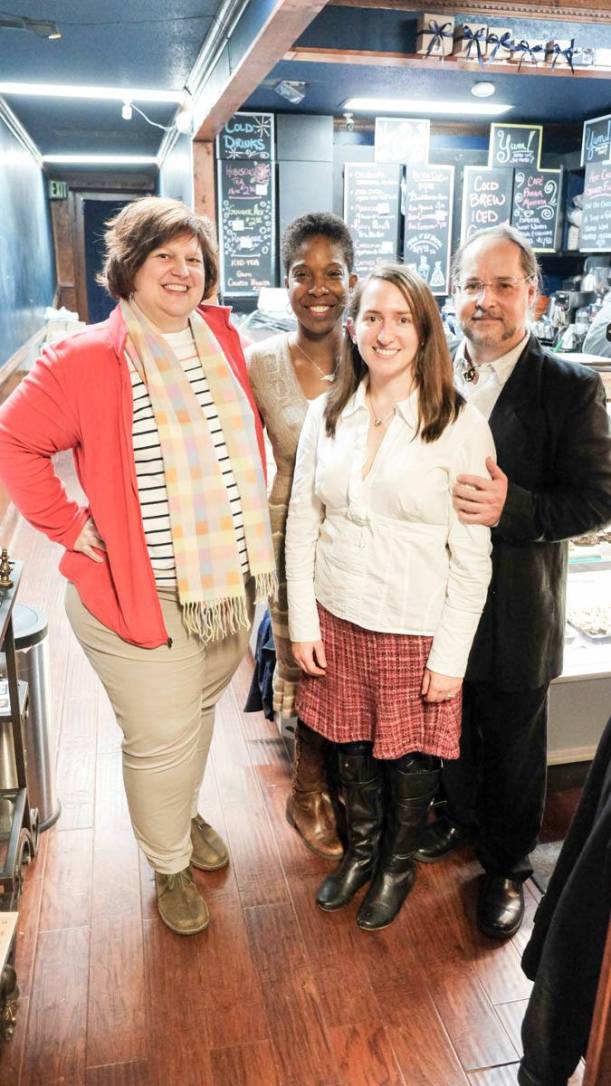
December: Made my final poetic appearance before moving to Massachusetts at Living Poetry’s Holiday Chocolate Open Mic. My Mother’s Child chosen as one of Sundress Authors’ Picks for Best Reads of 2015.
10259012_1541705862815967_8181251366639055957_o


7 Comments

A Poet Organizes Her Books and (Almost) Cries Trying


It’s been quiet on the blog as of late because the career side of the double life has commanded my full attention since the end of August.

First, the big news—I’m relocating to the Boston area and returning to higher education administration. The role involves providing data about student learning and outcomes so that the leadership can make better decisions. This position is similar to one I had at UCLA, except the focus is on undergraduates (and very impressive students at that).

I’m excited about this position for several reasons:
1) I get to return to a college campus—my favorite working environment.
2) The work I do daily has a direct effect on the strategic direction of the institution and the students it serves.
3) I have the opportunity to work with intelligent people who believe in the mission of the institution wholeheartedly.
4) I report to a manager who has made me feel valued and supported as a person and as a professional already.

I report to work in early January, which leaves a small window of time to pack and move. Of course, I started with the books. As a first step, I separated the books into three piles: must carry with me; could go to storage for six months if need be; and needs a new owner.

Identifying the books that needed to be donated was relatively easy. The paperback books went the Prison Books Collective in Carrboro. They accept all kinds of books, even my ethnic and gender studies books from grad school and numerous books on Spanish grammar and vocabulary. I donated the hardcover books to the Durham Public Library, mostly fiction books I had read and enjoyed, but didn’t need to carry with me because they were so large.

For some books, the decision to keep versus donate was a close call. For example, I donated Wally Lamb’s I Know This Much Is True (hardcover) but kept She’s Come Undone (paperback). I found duplicates as well—for colored girls who have considered suicide/when the rainbow is enuf by Ntozake Shange and The Namesake by Jhumpa Lahiri (hardcover & paperback). Clearly, I love both of these books enough to have bought a second copy at one point. I’ll give them to someone instead of dropping them off in the library donation bin.

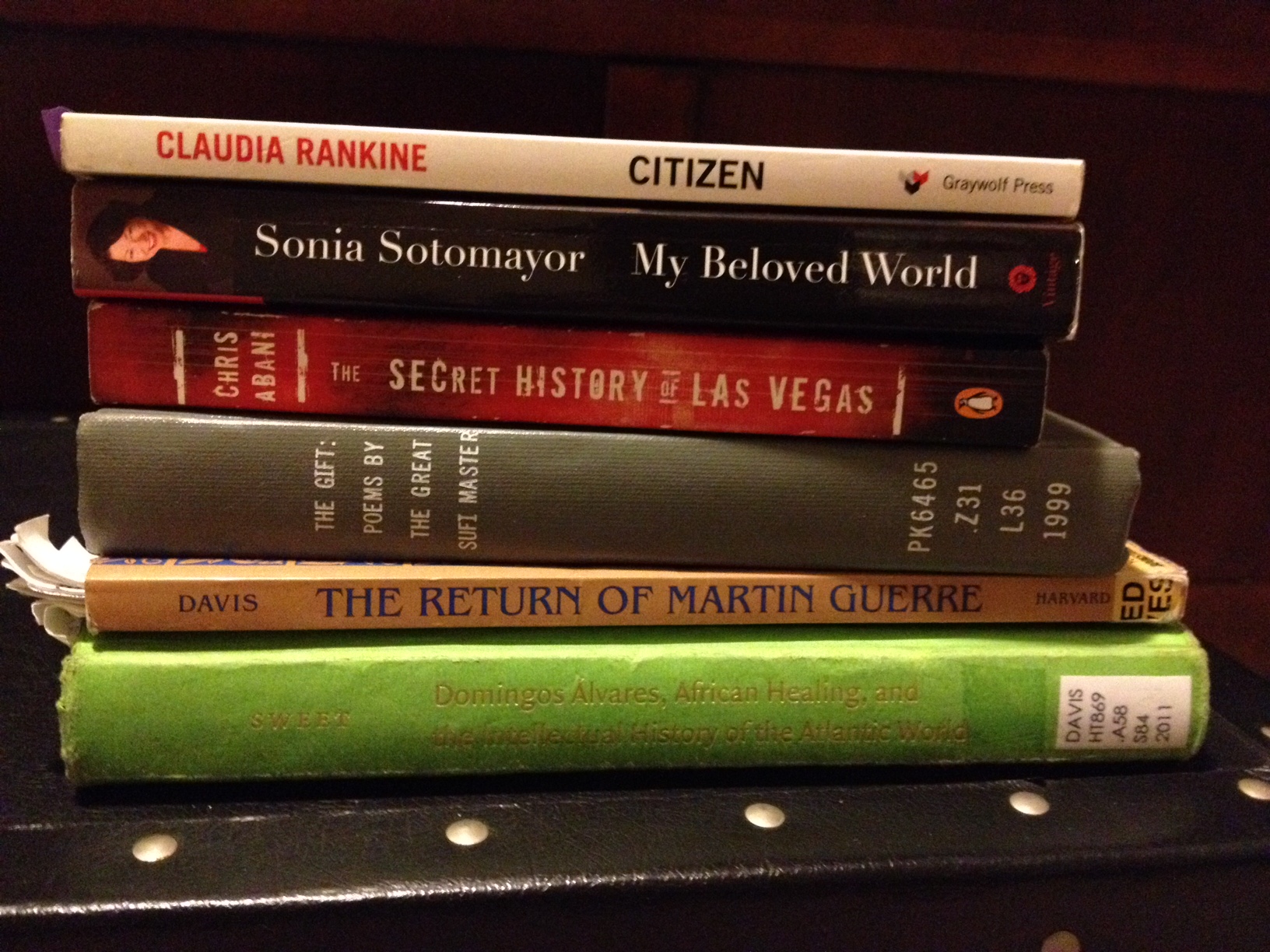
FullSizeRender(1)The books I chose to carry with me were no-brainers. Some of these books lived in my bedroom or in my car and not on bookshelves. I left them out because I liked seeing them everyday. A few I had read recently—The Essential Hits of Shorty Bon Bon by Willie Perdomo and The Secret History of Las Vegas by Chris Abani; others were classics—The Correct Thing To Do, To Say, To Wear by Charlotte Hawkins Brown, Lolita by Vladimir Nabokov, and The Sweet Flypaper of Life by Roy DeCarava & Langston Hughes.

By default, I needed to pack the rest of the books. I decided to organize them by genre before putting them in boxes, so I could easily unpack the books whenever I got settled. This process in one word: agonizing. I had to touch every single book I owned and fight back the urge to sneak it into the crates for the must-carry books. Some of these books have been on the to-read list for a while, but for each one of those books there is another I remember reading on the DRX bus or for poetry book club. They carry memories of my life in Durham because I bought most of these books during my 9 years here.

For some books, I had the comfort of knowing I had another book by the same author in the crates—Jaki Shelton Green‘s Breath of the Song in the crate; Conjure Blues in the box. What’s worse is that poetry books, in particular, are slim and can slip into the sliver of remaining space in the crate. It’s been hard to keep myself in line with my first mind.

I was so overwhelmed by the magnitude of the task and the reality of moving, I wrote this blog post instead of continuing to organize. At least no tears were shed during the process. 😉

IMG_6567


2 Comments

News from the Corner Office


PT ReadingTonight, I’m the featured poet for my favorite local reading series, Two Writers Walk into a Bar at Durham’s West End Wine Bar (7 pm). As the name suggests, the event features two writers—one poet, one prose writer—who each read for 20 minutes in the bar’s upstairs loft. The vibe is laid back and the readings always leave a word or a phrase etched on my mind. I look forward to the second Tuesday of the month, especially this one.

Thursday, I’ll be featured on the SAFTACast the bi-weekly podcast of the Sundress Academy for the Arts. This show focuses on the writer and whatever topics come up in the hour-long conversation with the gracious host, Scott Fynboe. Fitbits, hiking, and my worst dating story were a few of the things we discussed. Hyacinth Girl Press publisher, Margaret Bashaar and fellow HGP author, TA Noonan have appeared on the show.

Finally, with all this news, I’m launching a new page on the site: News from the Corner Office. This page will list my appearances and interviews and share a few photos. Deepest thanks to writer-blogger extraordinaire Tara Lynne Groth for this suggestion.


1 Comment

Summer Reading List 2015


IMG_6298August is flying by. My family came to visit in the beginning of the month, and since then, I’ve been busy with cookouts,  meteor showers, and birthday parties on top of the usual schedule of dancing, yoga, and poetry dates. I’m surprised that I even found time to read this summer. And my reading has been all over the place, thanks to recommendations from colleagues and friends.

Fiction

  • Everything I Never Told You by Celeste Ng: Borrowed from my colleague, this was the first book I fell in love with this summer. I related to much of the story—the pressure of being the overachiever, the isolation of being a minority—and thoroughly enjoyed the language from beginning to end.
  • Tell the Wolves I’m Home by Carol Rifka Brunt: Another borrowed book. Took me back to the 80s with its depiction of AIDS, Reagan, high school, sibling relationships, and New York City.
  • The Secret History of Las Vegas by Chris Abani: Ever read a mystery novel that centers on conjoined twins and where most of the main characters are Black? Me neither. That’s one of the reasons I’m enjoying it so much.

Poetry Book Club

  • Citizen by Claudia Rankine: A lyric essay which sparked as much conversation about race as it did about the poems and craft, if not more.
  • Black Zodiac by Charles Wright: A dense mediation which our small group thought inaccessible at first; together we came to appreciate the book, especially the last poem, “Disjecta Membra.”
  • The Gift by Hafiz: Just starting this book for our September meeting.

History/Non-Fiction


2 Comments

Five-Day Poetry Challenge


Old paper grunge background - Challenge yourself

Five-Day Poetry Challenge – DONE!

The 5-day poetry challenge is a popular meme where you post one of your poems (preferably published) to your Facebook timeline then tag another poet to continue the challenge. Last week, I was double-tagged by poets Anna Weaver and Elizabeth Jackson. So in true double-life fashion, I decided to post two poems each day—one of my published poems around 9 am and one of my favorite poems about the working world around 5 pm.

I selected poems from the range of themes I tend to visit and revisit in my work:

  1. Work: “Twenty Questions for Black Professionals” from my chapbook, My Mother’s Child (Hyacinth Girl Press, 2015)
  2. Love & Longing: “The Truth about Fire” published in The Pedestal Magazine in 2012
  3. Planets & the Universe: “To Earth, From Mars” published in Construction Literary Magazine in 2014
  4. Family: “At Night I Dream of Trains” published in the Grief issue of When Women Waken in 2013
  5. Tango: “If I Could Love You Like Tango” published in the anthology, …and love…(Jacar Press, 2011)

For the poems about the working world, I picked two of my favorites that I’ve posted to the blog before as well as a few poems that showed work and workers in a more positive light.

  1. “White, White Collars” by Denis Johnson, from The Incognito Lounge, 1982
  2. “Drone” by Wanda Coleman, from African Sleeping Sickness, 1990
  3. “The Gulf” by Brian Brodeur, from The Missouri Review, Winter 2010
  4. “Coming Closer” by Philip Levine, from What Work Is, 1991
  5. “Domestic Work, 1937” by Natasha Trethewey, from Domestic Work, 1999

Here’s the last stanza from the Trethewey poem that always sticks with me.

She beats time on the rugs,
blows dust from the broom
like dandelion spores, each one
a wish for something better.

If you haven’t been tagged, start your own 5-day poetry challenge. I’d love to hear about it.


4 Comments

VONA @ Miami 2015


vonalogoIt’s taken me almost a month to recover from the VONA workshop in Miami from June 28 – July 4, 2015. VONA (Voices of Our Nations Arts) is the only multi-genre workshop for writers of color. This year was the first time the workshop was held at the University of Miami. Previously, the VONA workshops had taken place in the Bay Area.

VONA workshops occur over two weeks; I attended the Week 2 poetry workshop with Willie Perdomo, whose most recent 11647246_10155790169525271_417854073_npoetry collection, The Essential Hits of Shorty Bon Bon, was a finalist for the 2014 National Book Critics Circle Award (Poetry). Other writers attended workshops for fiction with Evelina Galang, memoir with Andrew X. Pham, travel writing with Faith Adiele, speculative fiction with Tananarive Due, LGBTQ writers with Achy Obejas, and the residency group with Chris Abani.

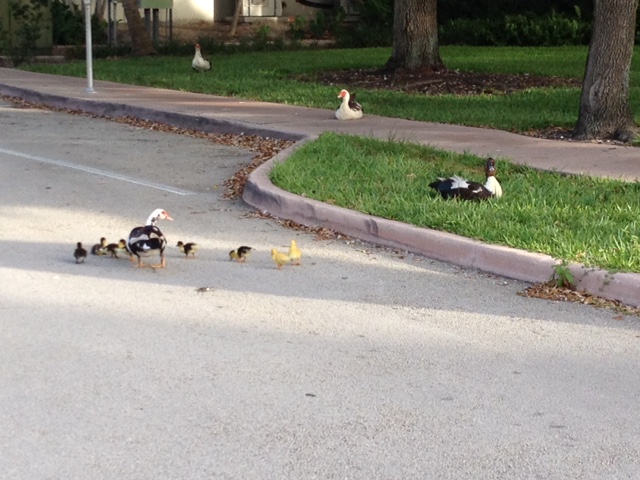
For me, the VONA experience was a fusion of VCFA and Cave Canem: there were old poems to IMG_6173workshop; new poems written every day; amazing faculty readings; inspiring student readings; and a culminating dance party. Of course, nothing compares to the beautiful U of M campus, complete with the lush orange flowers of the royal poinciana trees, free-roaming duck and ibis families, sudden thunderstorms, and crocodile warning signs.

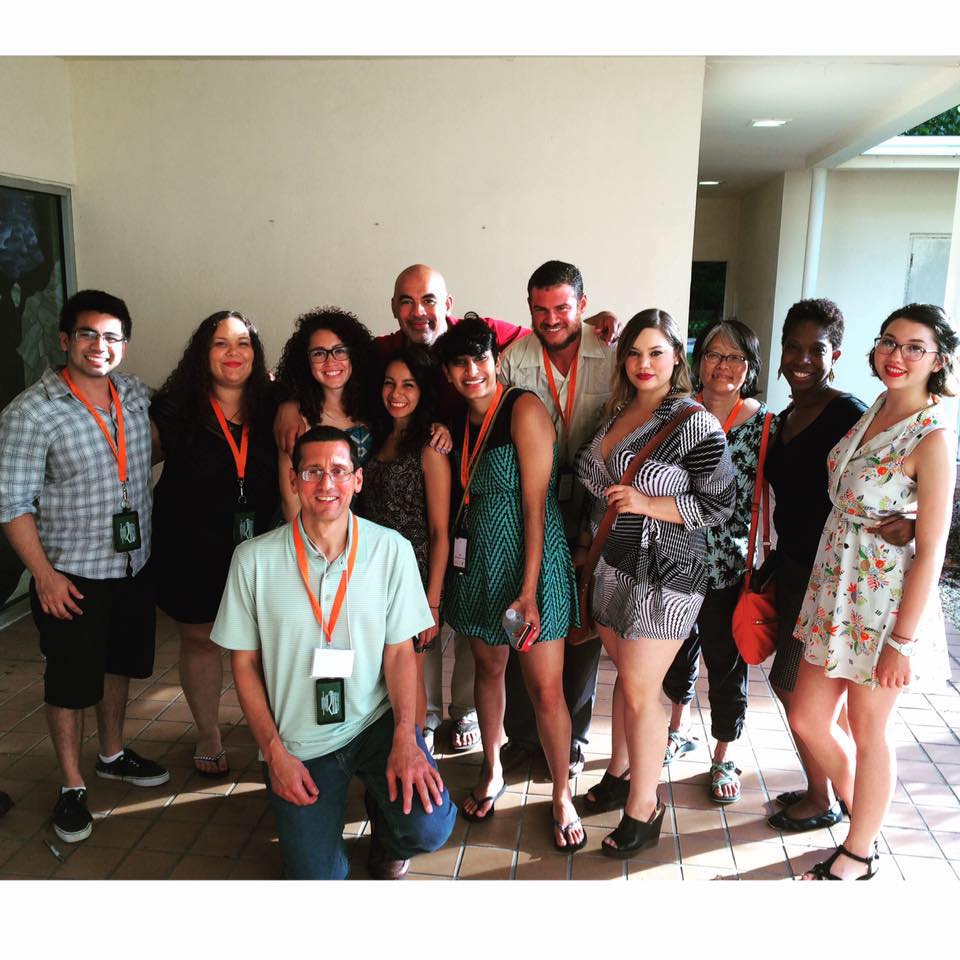
What makes VONA a unique experience is the opportunity to interact with other writers of color. Although we spent most of the time in our workshop groups through lunch, there was ample time to hang out in11411900_130970943903971_6529621702020454391_o the VONA lounge to chat with writers from other genres about their lives back home or watch them work on collages. For me, the highlight of  VONA was the group presentation from the speculative fiction writers whose worm holes trips misplaced them in all the other genres until they found their way home.

Nothing about my time at VONA Miami would have been possible without my lovely suitemates—Elizabeth Zertuche (Apex, NC), Yesenia Flores Diaz  (Maryland), and Dipti Singh (Bombay)—and my awesome poetry 11709272_705508246242186_6326447500570548388_nfamilia—Rebecca Brown (Chicago), Tomás Nieto (San Diego), Peter Noble (New Haven), Bobina Vander Laan (Richmond), Fatimah Ashgar, June Inuzuka (Denver), Michelle Moncayo (New Jersey), Charles Snyder (Long Beach/Bay Area, CA), Bianca Garcia (Miami), and Sarah Serrano (Brooklyn). Livelong connections!

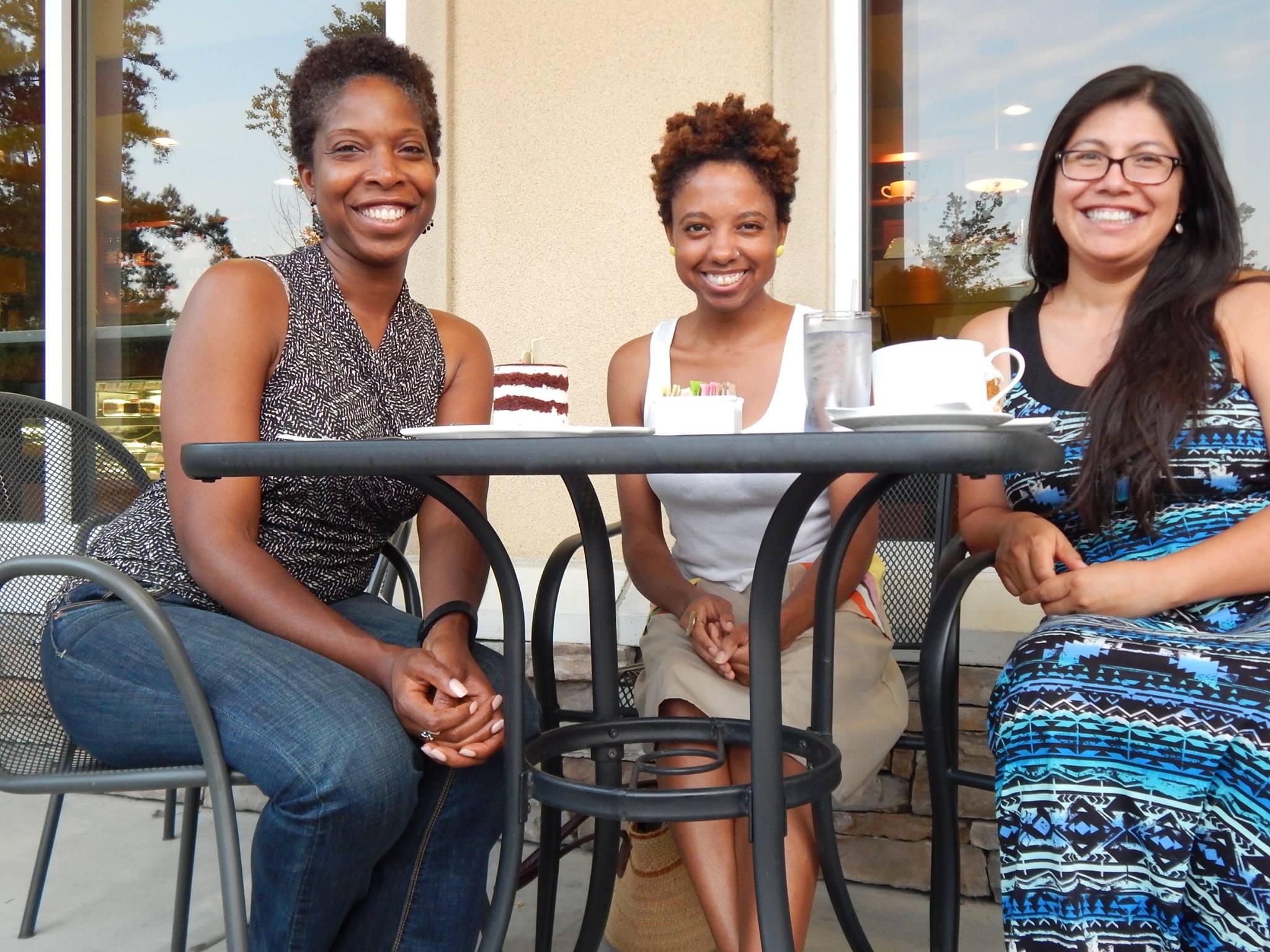
VONA encouraged writers to form affinity groups to stay connected once we returned home. In addition to my roommate, I met other writers from NC as well as from the I-85 corridor (Richmond and Atlanta). Last Wednesday, the VONA NC branch met in Durham at Dulce Café. We commiserated about our slow recovery from the VONA immersion and our attempts to get back into the habit of writing now that we were fully back in our normal

VONA NC members: me, Cantrice Penn, and Elizabeth Zertuche

VONA NC members: me, Cantrice Penn, and Elizabeth Zertuche

lives. At the end, we promised to meet again in August at my house to write together and keep our VONA-flow going.


2 Comments

Poems for King Pluto


Pluto's Frozen Heart. Credits: NASA/JHUAPL/SWRI

Pluto’s Frozen Heart. Credits: NASA/JHUAPL/SWRI

Last Thursday, I had the opportunity to write a poem in honor of the King of the Dwarf Planets—Pluto—as part of the NC Museum of Natural Sciences weekly Science Café talks. NASA Ambassador Shawn Bayle provided background about Pluto and the New Horizons mission that has been transmitting stunning images of the ninth rock from the Sun.

This event was the third time the museum had invited Living Poetry members to craft poems inspired by a science talk:

Pluto's Poetesses. Credits: Erin Osborn & Alice Osborn

Pluto’s Poetesses. Credits: Erin Osborn & Alice Osborn

I don’t think it was accidental that old King Pluto had four ladies scribing in his honor. He’s got that effect on women—ask Proserpina (aka Greek’s Persephone) and his largest moon, Charon, which is gravitationally locked in sync with Pluto’s orbit so that the two celestial bodies always face each other. Some other facts about Pluto and the New Horizons mission gathered from the talk and mentioned in the poems:

  • discovered by mistake by American astronomer Clyde Tombaugh in 1930 in search for Planet X presumed to exist beyond Neptune
  • first object identified in the Kuiper Belt
  • New Horizons took 9 years to get to Pluto; the gravitational boost from Jupiter reduced the time to get to Pluto by 5 years.
  • scientists discovered two of Pluto’s moons—Styx & Kerberos—after the New Horizons spacecraft launched in 2006

I enjoy writing planetary poems already but especially at these events because I can hear similar threads in each poem while noting each poet’s unique voice. I’ll share an expert from my poem here, “New Horizons Meets Planet X,” but be sure to watch the entire talk on YouTube (poets start about an hour into the video).

Feed me your data in bits
and bytes as we shimmy
in front of Neptune to soak

up the sun. I don’t see any rings
around you, so maybe we can
make a new moon or two.


2 Comments

Planetary Influences


Transit of Venus June 5, 2012, NASA/Goddard/SDO

Transit of Venus June 5, 2012, NASA/Goddard/SDO

One of the first poems in my chapbook that was published was “Transit of Venus,” which was inspired by the 2012 event that will not happen again until 2117. What I saw with my own eyes (black drop / crossing / the sun / dipping down / curving around / up again) is now visible in some amazing pictures from a joint project between NASA and the Japanese Aerospace Exploration Agency. I consider the Venus poem the first in a series of poems about the planets I intend to write. Last year, Construction Magazine publishedTo Earth, From Mars,” the second planetary poem, and I wrote “Pluto, My Brother” at my last Cave Canem retreat (back in my day there were 9 planets). My poetry-date partner, Kelly, says the Pluto poem is ready to send out, so I’ll be spending some time this weekend in the Poet’s Gym (aka UNC Davis Library) figuring out where it should land.

Photograph via Flickr by bluedharma

Photograph via Flickr by bluedharma

I love writing about the planets and other objects in the universe. They are like our distant relatives: made of the same stuff but existing in a different era. Poetry offers a unique way to consider the beauty and individuality of each body as well as explore the myths and folklore we project onto each globe. I’ve also written  poems about the spacecraft we’ve sent to explore other objects in our universe. My biggest challenge is *getting the science right* inside the poem. Often, the scientific terms are not accessible or pleasant-sounding to the average reader. It’s my job to make the connection between science and metaphor so that we can understand each planet on its own merit as well as how it relates to our own lives.

Tonight, I will get another opportunity to write about Pluto at the Science Cafe at the NC Museum of Natural Sciences. The talk will feature some of the stunning images taken of our dear *dwarf* planet from the New Horizons probe. I can’t wait to see what these new images inspire.

NASA Instagram photo of Pluto from New Horizons

NASA Instagram photo of Pluto from New Horizons

Chapbook Party!

4 Comments


On Friday, June 26th, I had the launch party for my chapbook, My Mother’s Child. Thanks to my tango-friend Mariana, I was able to have the party at Terra Nova Global Properties new office in downtown Durham. And my friend Janet provided the food, decorations, prosecco, and the real champagne glasses.


11246038_10206233623896656_2804387990603404117_o11667352_10206243304098655_3920927146387054198_nIMG_614711053397_10153410493047224_290307427375927557_o

After a fabulous introduction by fellow Living Poetry organizer, Bartholomew Barker, I read a four poems from the chapbook and a few others I had written over the last two years. Many in the crowd had followed my April and November poem-a-day challenges and a few had never heard me read before. I’m so thankful to everyone who came out to support me and buy books.

This gallery contains 15 photos


12 Comments

My Mother’s Child: A Chapbook


11402606_10206120537869576_2450195489782527196_oMy chapbook is finally here, My Mother’s Child published by Hyacinth Girl Press. In my last post, I promised to share the details of this amazing journey.  Although some of these poems were written almost four years ago and about 10 months elapsed from signing the publication contract to publication date, it’s really felt like a serendipitous labor of love.

  1. The Poems. I can trace the origins of some of these poems back to 2011 in my second semester at VCFA. I wrote other poems at two Cave Canem retreats, in response to a visual prompt at my weekly writing group, Written Word, and a workshop through the Raleigh Review. I know many of these poems started as hunks of stone scribbled in my notebooks while commuting on the DRX bus and were later revised during my times at UNC Davis Library (aka The Poet’s Gym). Six poems were previously published; five in 2013 and one in an anthology published in 2014.
  2. The Chapbook. Assembling chapbook is different than putting 3-5 poems together for a journal submission or workshop application packet. The poems have to speak to each other and belong together. After a year of submitting to contests for full-length collections and getting nowhere, I changed my strategy. When I sat down to look at all the poems, they seemed to separate themselves into two groups with a few bridge poems. Depending on the chapbook contest guidelines, I included more or fewer poems. I probably had 3 or 4 different configurations.
  3. The Contest. I entered My Mother’s Child into the Imaginary Friend Press chapbook contest in 2013. I liked this contest because it was specifically for anyone who did NOT identify as a heteronormative white male. Although I was a finalist for this contest, one of the judges, Margaret Bashaar, asked to publish the chapbook through her small press, Hyacinth Girl Press. This could not have happened if I didn’t enter contests and submit my work.
  4. The Cover Art. This amazing sketch was done by a local artist, Jolmar Millar (4th photo). I met Jolmar at a tribute event for Maya Angelou I emceed in November 2014. When Margaret gently nudged me about cover art, it took a while before I thought of Jolmar. And then when she came to mind, I didn’t have her email address. I emailed a mutual contact for Jolmar’s email address and the email went to spam. Then about a month later we were connected.
  5. The Publication Process. This process is no joke, and being a newbie, I didn’t know what to expect. There comes a point where you have to let go. Having a wonderful publisher and layout person helps. I still don’t think I caught everything, so don’t be too hard on me if you find something.

Here’s an excerpt from a poem that started out as an image I couldn’t get out of my head while driving to a poetry-on-demand event at Cloer Family Vineyard in April 2012. The first draft was written at Cave Canem in June 2012.

What makes sense disappears
under straw hats,
this bizarre America,
where they pay
to return to rural
roots my people fled—
that second Exodus
to auto plants, steel mills,
city-hard streets—
so I wouldn’t
have to stand in sweat
tasting the dry,
salted past
on my tongue.– Stuff White People Like #132: Picking Their Own Fruit, from My Mother’s Child – See more at: http://hyacinthgirlpress.com/yearfive/mymotherschild.html#sthash.q08uIMgj.dpuf