A Poet's Double Life

For poets working outside the literary world.


5 Comments

The Poems I Need to Write


Lately, I haven’t been writing much because the double life is working overtime. My daytime career is chock full of project meetings and deadlines. My evening career is tying up loose ends with preparations for poetrySpark next weekend. Most nights, I collapse on the couch and veg out in front of the TV, often falling asleep before I realize it. And I feel guilty about it. Don’t real poets write at every possible moment? If Mary Oliver could get up at 5 and write for a couple of hours, isn’t that what I should be doing?

Instead of being so hard on myself, I am trying a different tactic—writing poem ideas down. Often the topics come in the form of working titles and a line or two that might be in the poem. Here’s my list so far:

Suiting Up: “If I don’t belong, at least I can dress the part”
Natural Hair: “Yes, natural hair is making a comeback everywhere—except my mother’s house”
Cleaning up the Break Room: “She wipes away the crumbs so they won’t think we’ve left a mess behind”

Then there are the planetary poems about I need to write to go along with the “Transit of Venus” poem I wrote during Cave Canem:

Mercury in Retrograde
Curiosity of Mars
House of Saturn

And the science-based poems that with any luck will turn into extended metaphors about race:

Dark energy/dark matter inspired by Adler Planetarium in Chicago.
Dark spot corrector inspired by a casual conversation with one of the inventors

I might have a trio of “Stuff White People Like” poems if I can ever finish that poem about yoga (#15) and start that poem on grammar (#99)

And just yesterday, I got the idea to write persona poems about famous women in technology

Lady Ada Lovelace – 1st programmer and daughter of Lord Byron
Grace Murray Hopper – found the first “bug”
Patricia Selinger – creator of stored procedures

Whenever I do get time to write, this list will keep me plenty busy!


4 Comments

Living the Double Life


“One of the saddest things is that the only thing that a man can do for eight hours a day, day after day, is work. You can’t eat eight hours a day, nor drink for eight hours a day nor make love for eight hours — all you can do for eight hours is work. Which is the reason why man makes himself and everybody else so miserable and unhappy.” ~ William Faulkner

Often I feel disconnected from other poets who teach for a living, are freelance writers, or who have a job where they work with words, language, books, or images all day. My job taxes my analytical mind. I spend a lot of time in meetings, in the field gathering evidence, or in front of my computer processing information and data to identify problems and generate ways to solve them. My colleagues know that I am a poet, and send me links to poetry contests and articles about poets they happen to come across. They are used to it, having spent two years creating workarounds for my two-week stints in Vermont in January and July. They know I am “poeting” when they see my closed office door during the lunch hour. But I don’t expect them to understand anything about sonnets and I don’t try to steer the break room conversation away from “So You Think You Can Dance.”

Most poets I meet are full-time poets. They recognize what I do as important, but clearly unrelated to anything literary. Some can recount the litany of odd jobs they’ve had while they were finding their way to their first book or teaching position. But most let their eyes glaze over; they don’t understand how I can do something other than poetry all day and call myself a poet. Unfortunately, these are the same people who are editing literary journal and magazines, and don’t seem to relate to the poems I write about life at the office. Thankfully, my poet-friends are sympathetic to the double life because many of them have to carve out time from work and family to continue to do what they love to do.

I started this blog to be a place for poets with non-literary careers. The people, who like me, have both feet firmly planted in their careers and the poetry world. We have to work hard to succeed on both fronts and don’t want to have to choose between them. As much as I would love to live on poetry alone, I truly appreciate having a job that gives me the freedom and flexibility to pursue poetry. I don’t have summers off and my job wouldn’t pay to send me to the AWP Conference as part of my professional development, but I can afford to pay for plane tickets to writer’s weekends. And the 9.16667 hours in vacation time I earn each month can be used however I want, even for another trip to Puerto Rico.

So on this Labor Day, I wanted to express my gratitude for my other career, the one that allows me to live the double life.


Leave a comment

Finding a Home for Your Poems


A good friend once told me, “Dating is all about getting the at-bats.” The same can be said about publishing poems. Part of my struggle is the time it takes to sift through my VCFA manuscript and the poems I’ve written since graduating in January to figure out which poems I still feel good about sending, which ones still needs revision, and which ones make me shake my head (What was I thinking when I wrote that?!).

Last month, I posted about my first time sending out publications, and now, I am gearing up for a second round. My pool of poems is limited by the submissions that are pending and whether the lit mag accepts simultaneous submission. So far, I’ve heard news only about 2 out of the 5 submission – a “nice rejection” (try again) and an acceptance 1 out of the 3 poems I sent (yay!)

This time, I’m using these sites to identify literary magazines:

  • Duotrope – has a submissions manager to help track the results of your submissions, lists new, defunct, and resurrected literary magazines, and allows writers to search for a good match
  • New Pages – maintains the “Big List of Literary Magazines” with reviews of each publication as well as links to their websites

Browsing through each site is a bit overwhelming, but I find comfort in knowing there are so many possibilities out there. It gives me hope that each poem will find the right home. Now if only dating worked the same way. 😉


2 Comments

Poetry Prompts


Last week was one of those weeks when my writing rhythm was thrown off by travel and late nights in Raleigh for work and poetrySpark.  When I can’t think of anything to write or haven’t written in a while, prompts are a way to jumpstart the creative juices.  Luckily, one of my responsibilities for Living Poetry is sending out the weekly poetry prompt. Every Monday on the ride into work, I have to figure out what the prompt is going to be—which means focusing my energies on thinking about what topic might possibly inspire me to write.  Here are a few of the prompts I’ve used so far:

skin * breath * night *  fireworks * the smell of mint

Recently, I started using a visual prompt on the 3rd Monday of the month. Last month, a photo in the UCLA Magazine inspired this poem:

Carbon Footprint

From the “Vegan Campus” article in UCLA Magazine: http://magazine.ucla.edu/features/the-vegan-campus/index1.html

I want to leave
something behind,
more than this poem,
this page, this pen,
a lineage beyond
what my fruitless
loins choose to bear.
In time, the mind purges
any memory too heavy
to carry. The soul
must be free to take
the next step without
a trace of regret.

Today, I sent out a photo from National Geographic. I’ll post the poem I come up with next week.


3 Comments

City-Inspired Poetry


As a double-life poet, you have to find ways to keep yourself creatively inspired. It is so easy to let work and the rest of your life crowd the poetry out. Last week, I traveled to Chicago for a non-literary conference.  Although two of my work colleagues were there, we attended different sessions and kept our own company afterward. My first day in the city, I took an architectural boat tour with one colleague and her daughter. Afterwards, I found a place to eat outside. I was dutifully chceking Facebook when I heard this shuffling sound. I looked up to see the guard and watched as he made his way around the block. I didn’t think to take a picture, but I did manage to jot down this poem:

The sound of the shuffle precedes
His overhang belly with shirt
buttons stressed, but holding
his uniform blue in tact as the slow
waddle of his patrol rounds
the corner of Michigan Ave.

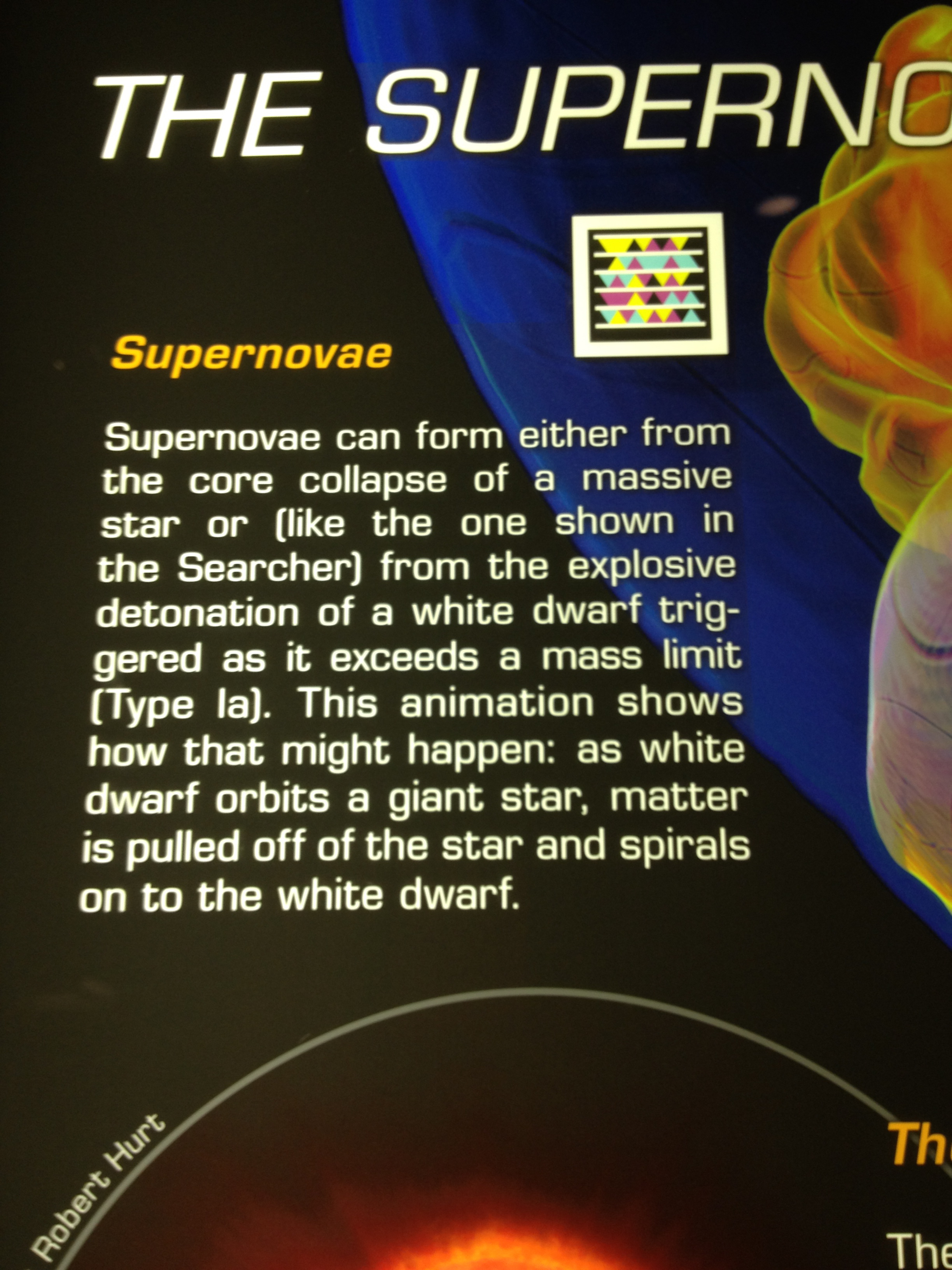
My time at the Adler Planetarium  also stuck with me. I’ve always been fascinated by the ideas of galaxies and universes far beyond this one. And I’m sure reading Tracy K. Smith’s Life on Mars re-ignited my interest in the planets and stars. After watching the planetarium show, The Searcher, I stuck around to ask the guy behind the booth about supernova. His explanation and the exhibit on the topic provided the details needed for this poem:

You were a red giant star
eons beyond your white-yellow hot,
destined to expand into oblivion.
I refused to let you go, kept orbiting
around you, drawing your energy
to fill myself like a helium
balloon—tethered to the whim
of your finger—swirling past
my limit to our beautiful
demise, this spectacular disaster.

And finally the explanation of dark matter next to the supernova display led me to this poem:

A Different Kind of Matter Altogether
Dark matter doesn’t
interact with light.
It is too dominate,
too heavy, too much.
This is Universal Law–
the lesson I  forgot
to learn because
I was too busy
trying to be
like everyone else.


2 Comments

Finding Poetry


This double-life poet worked overtime on both fronts this week. The poet staked out old and new writing spaces, made five poetry submissions for her boot camp obligation, and went to the poetrySpark planning meeting on Tuesday.  The data guru was busy in meetings for five projects, reviewing project notes and report drafts, and designing interview protocols. The poet thought about going to an open mic on Thursday, but decided to stay home so the data guru could pack for a conference in Chicago. Neither one of us had much down time to think or process what was seen, heard, or experienced, let alone make a dent in the summer reading list.

It’s easy to lose touch with creativity, especially when the business of poetry is what is keeping you uninspired.  When I first got the idea for this blog post, I was riding on the DRX bus, typing on my iPhone when I could have been reading on the Kindle or writing in the  journal I take everywhere. But in between the search for words on the page, I looked up and found little bits of poetry sprinkled here and there:

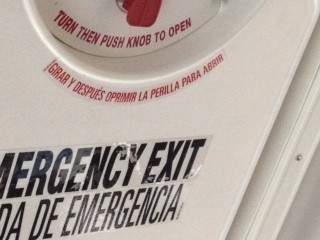
Emergency Exit

Exits are identified by red
Handles on the side of windows.
Locate your nearest exit.

This sign is posted on the back of every seat. I’ve read it a thousand times, and each time, the line break between ‘red’ and ‘handles’ still amazes me. I know the decision to break the line there was based solely on the available space on this 3×3 inch placard, but it is a stroke of genius!  Then there’s the haiku-like quality of this sign:

 Turn Then Push Knob to Exit

Girar
Y después
Oprimar
La perilla
Para abrir

Although this sign poem is in Spanish, the rhythm, the alliteration in the ‘p’ sound, and the assonance in the ‘ri’ diphthong are unmistakable. I have to look up to see the sign, which I often forget to do. Usually, I’m too wrapped up in thoughts or a book to see the poetry around me. But I always enjoy it when I do.


3 Comments

Lessons from a Publication Virgin


I’m coming to the end of my first month of publication boot camp. Yesterday, I submitted 4 out of the 5 required submissions. Of course, I procrastinated until almost the last possible date. I could blame it on the Charlotte trip last weekend, but really it’s the intimidation factor. How can my poems compete with the likes of Marilyn Nelson, Billy Collins, and Kim Addonizio? Or even my previous VCFA advisers, Rick Jackson and Ralph Angel? But I faced my fears and sent my poems out in the world. I thought I’d share what I learned in case there are others out there like me, who want publish but don’t know where to start.

How to prepare a submission: To start, I printed out all of the poems I thought were ready and grouped them according to which poems complemented each other in terms of theme or style. I wanted poems that varied a bit in terms of length and form to demonstrate my poetic versatility (or so I hoped). During this process, I found myself tweaking line breaks, rearranging stanzas, and even, holding back some of those “ready-to-send” poems for next month. Then I needed to prepare the submission itself. Like any other workout regimen, there’s a learning curve in how to prepare poetry submissions. The best advice I read was on Poetic Asides: follow the submissions guideline to a T. This post also had sample cover letters, which I promptly copied and edited for my own purposes. Because I don’t have a long track record for publication, I kept the part about lauding my laurels in the cover letter short. Based on my own experience as a reviewer for Hunger Mountain, the cover letter is not as important as the poems themselves.

Where to publish: OMG! There are so many literary magazines and journals out there, it is impossible to keep up with them all. Luckily, I frequent the periodicals section of UNC Davis Library. Sometimes I just walk through the stacks in alphabetical order, grabbing armloads of recent issues off the shelves. I take about two hours to browse through literary journals to discover poets I’ve never heard of and keep abreast of what’s hot in contemporary American poetry (or at least what is getting published). For those “new-to-me” poets, I usually go up to the 8th floor to find their most recently published book to read other poems and figure out other places they’ve been published. Those lit mags go on my mental list to read the next time I’m browsing through the stacks. Recommendations also come from the places where my poet-friends have been accepted or rejected.

What to send where: Every lit mag says they want your best work, but not all of them take simultaneous submissions. So then you have to decide what to send where. This is where being familiar with the lit mag helps because it gives me a sense of which poems I could see published there. All guidelines state the maximum number of poems per submission. Again, I can draw upon my experience as a reviewer. Hunger Mountain accepts up to 10 poems, but I only need to read 3 poems to get a sense of the poet’s work. So each of my submissions contained 3 poems, with the exception of Cimarron Review, which got 4 poems with titles beginning with the letter T (not sure how that happened). I included the last poem, “Tour Guide at Río Camuy Caverns,” after reading the three most recent issues at the library.

The final step in this lesson is waiting—which I’ve just started learning how to do.


Leave a comment

Poetry on the Go!


Being a poet with a non-literary career means I don’t always have time to keep up with the latest poetry happenings. I need to know what’s buried in the state budget bill as much as I need to know how to craft a sestina. And even though poetry books are slim enough to fit into my favorite purse, I can’t carry the seven books I’m currently reading at the same time, not to mention the novel and classic craft book on diagramming sentences I just bought (more on my summer reading list in another post).Poetry iPhone Apps

That’s why a smartphone is a double life poet’s best friend. I have three mobile apps that let me access poems anytime:

  1. Poetry Daily: Sends a new contemporary poem each day, provides info on the author and links to the book or literary magazine that published the poem
  2. Poetry App from Poetry Foundation: Allows poetry lovers to browse poems by mood, subject, poet, and in the online audio archive
  3. Poem Flow: Daily poem with a visual component

In addition, I have Dictionary.com and a rhyming app on standby in case I get a flash of inspiration while riding the bus. A recent article on Make Use Of.com lists other must-have-apps for poets.

If you’re a self-proclaimed Luddite like several of my poet-friends, don’t worry! The apps I mentioned can be accessed online or sent to directly to your inbox. In fact, several websites have daily or weekly newsletters with useful information for poets. My favorites are Writer’s Almanac by Garrison Keillor, which features a daily poem and interesting facts in literary history, and About.com Poetry, where you can sign up to receive weekly poetry news or 30 poems for 30 days.

Also, two poetry organizations feature information and insight into the poetry world.

  1. Academy of American Poets fosters appreciation of contemporary poetry and has resources for poets at all stages on their website, Poets.org. You can sign up to have the poem-a-day or one of their 5 newsletters sent to your inbox, including  opportunities for community involvement.
  2. The Poetry Foundation publishes the literary magazine, Poetry, and offers many resources and awards to poets. Scrolling to the bottom of the website will give you several options to keep your inbox or favorite RSS Feed reader filled with poetry, including an audio poem of the day.

I also subscribe to poetry podcasts via iTunes and listen to them on my daily commute on the DRX bus or in the car.

  • Poetry Off-the-Shelf (weekly)
  • Poem Talk (monthly)
  • Living Poetry podcast (occasional)
  • PoemCast (archive)

Let me hear about how you take poetry on the go by leaving a comment!


4 Comments

Finding Inspiration


When I started writing, words poured out of me as if drawn up from some unknown emotional well deep inside. Poems flooded the pages, but it wasn’t until much later that I considered myself a poet instead a failed novelist. My emotional state directed the content of my writing: feelings of love, loss, and longing became the heart of the poems. Here’s an example:

I miss our magic

I miss the way your kisses taste like kisses are supposed to taste

I miss those four moles that form a constellation on your face

I miss the way you look at me and stare into my soul

I miss the easiness I feel when you take control

I miss you

Even though I’m not supposed to

Fast forward to Vermont College of Fine Art’s low-residency MFA program. For two years, I wrote 3-6 poems every month. I didn’t have the luxury to wait for the Muse to rifle through all the emotional boxes in the attic. I had to take inspiration wherever I could find it, even from the view of the old location of Chapel Hill Public Library:

Here is where I connect

to the essence of everything unfolding.

Here is where I witness

how life stripped down can be just as full.

But I already see buds forming on the leaning maple.

Soon an abundance of green will block the view outside.

(excerpt from Pritchard Park)

Now everything I see, touch, taste, hear, or smell can inspire a poem. The poems I wrote at Cave Canem ran the gamut of topics: my brother, my father’s death, unrequited office romance, professional development, berry picking, and the transit of Venus. Lately, I’ve inspired by photographs and movies like this one:

You were loose once

and then a mysterious

finger twirled you

around itself. You begged

for the ride to stop

and when it did, the middle

and thumb used you to strum

their pain. And now the ring

finger pulls you ever so

gently to your edge.

Fearing you will snap

at any moment, you beg

for the all-powerful hand

to release you and scream

when you reach your limit.

But then the pinky

hooks and stretches you

just a little more,

just to prove you wrong.

Images are a good starting point for expressing an idea connected to something I have observed or experienced. It is my job to find the words to let you, the reader, see this snippet of the world through my eyes.