
Three years ago this week, I heard the term “low-residency MFA program” during a lunch conversation with Cathy Smith Bowers, my workshop leader at the NC Writer’s Network Squire Summer Residency Workshop. My double life poet-friend, Joan McLean, asked Cathy to tell us more about the low-res program where she was faculty, Queens University of Charlotte. I called myself just listening to the conversation, but the more she talked about the structure of the program, the more curious I got. On the drive from Swannanoa to Durham, I decided to follow her advice and look into the low-res programs in the South––including Warren Wilson, the workshop’s host campus––and apply.
So how did I wind up in Vermont? Well, first I have to start with how VCFA got on my list. A simple Google search (“low residency MFA south”) turned up the programs at Spaulding University in Kentucky and Converse College in South Carolina. The other programs on my list were the two programs I had just discovered: Warren Wilson and Queens University of Charlotte. But as I reviewed the rankings on Atlantic Monthly and read what current students said about their programs on the MFA blog, Vermont College of Fine Arts started to emerge. The faculty and residency schedule looked good to me, and the length of the program, number of residency days, overall cost, and application requirements were comparable to its southern low-res counterparts. But most importantly, I was excited about the opportunity to study translation as well as the summer residency option in Slovenia. So VCFA got on the list, but I considered it a pie-in-the-sky program. Of course, when I got the welcome-to-the-program phone call from Director, Louise Crowley, going to VCFA became my reality.
And what a wonderful reality it turned out to be! In two years, I completed four semesters of creative work and five residencies–– four in Montpelier and the inaugural winter residency in Puerto Rico in 2011. During that time I wrote and revised over 60 poems, wrote a critical thesis on the poetics of work, assembled a collection of poems as part of my creative thesis, “Oddball”, and presented a lecture that inspired this blog, “A Poet’s Double Life.” 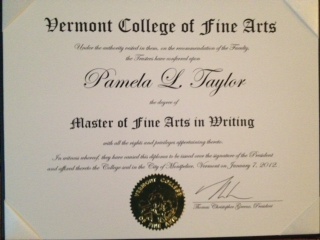 The program made me get serious about my poetry career. This dedicated time improved the quality of my poetry because I received individualized feedback on my work from a well-regarded poet. Participating in the residency workshops gave me the skills to read and critique poems. Having a personalized study plan exposed me to different poets, poetic styles, and issues of craft and helped me learn that reading is the number one way to bring issues of craft to life and inspire my own work. But what I cherish the most about the program are the lifelong connections with my fellow students, people who love poetry and writing as much as I do, and who as a group, are an indispensable part of my life as a poet.
If you’re thinking about a low-residency or traditional MFA program, you should definitely do your own research to find the program that is right for you. Poets and Writers magazine has ranked MFA programs in 2011 and 2012 and the Association of Writers & Writing Programs has a graduate program database.
Let me know your thoughts about low-residency MFA programs by leaving a comment.

 A Poet's Double Life