A Poet's Double Life

For poets working outside the literary world.


4 Comments

Lessons Learned from the November Poem-a-Day Challenge


For the past three years, I’ve done the poem a day challenge for National Poetry Month in April. But at Cave Canem , I learned about 30-for-30–writing a poem a day in the months with 30 days (April, June, September, and November)—and decided to give it a try.  Here are a five things from this experience:

 #1:  November is a good month for the challenge. It is far enough away from April (sorry, June) and not crazed with poetrySpark like September. Also, doing a PAD challenge in November is a show of solidarity with my prose-friends attempting to write 50,000 words in a during NaNoWriMo—National Novel Writing Month. I’ve decided to do the challenge in April and November from now on.

 #2:  It is impossible to do a PAD challenge alone: Although I was only one among my local poet-friends doing the PAD challenge out of season, I discovered that the Poet Laureate of Rockland Maine was doing the challenge too. Also the numerous Facebook comments and email responses to the poems reminded me there were people who appreciated that I was writing poems—no matter the month.

 #3:  I don’t need prompts: Unlike the April PAD Challenge, I didn’t follow the Poetic Asides blog. Doing a challenge without prompts meant that I had to be open to the inspiration coming from anywhere: a photograph, an email from a friend during her vacation, or a story I heard

IPhone Poem "At the Bottom of Mercury"

IPhone Poem “At the Bottom of Mercury”

on NPR. When I got stuck, I cultivated those seeds in my poetry notebook, scrolled through my iPhone notes, and found the time to write 5 poems from the list of poems I needed to write. It felt good to finally bring these ideas to life on the page. Now I have something to revise.

 #4: I need to trust that a poem will come out. So much went on this month: the first week of November, my mind was preoccupied with the Hurricane Sandy aftermath in my hometown; the second week, a close friend of the family died and my mother and I attended the funeral; the third week, I caught a cold and had no energy for much of anything; and last week I had a good friend visiting from LA and spent almost every night out. Not to mention that Mercury went retrograde from November 6th-26th, making any form of communication that much more difficult. And I still managed to write a poem every day! You’d think I would have learned this lesson by now, but obviously I needed this experience to become a true believer.

 #5:  I need to share my poetry more: Typically I post the daily poem to my Facebook notes (which can be hard to find if you don’t know where to look) and send it via email to about 30 family and friends who don’t use Facebook. I’ve tended to keep the poems slightly hidden in case I want to publish them later. But I’m having a change of heart. Out of the poems I write during the challenge, I submit about 6 or 7 and they go through extensive revision before I send them out. I’m starting to so I feel okay about posting them to a wider audience, so come April, I will also post the poem-a-day here.



1 Comment

My Poet’s Notebook


Most of my poems were born in a 4.3 X 6 inch Picadilly wire-bound journal I bought for $4.99 in the bargain section of Barnes and Noble. I used to have separate notebooks—one for thoughts, one for dreams, and sometimes a third for my to-do lists—but I’ve consolidated to one notebook for my entire life because everything is connected, isn’t it? I’ve saved over 30 notebooks, going back to 1999, though I didn’t always write in them on a regular basis. And of course, I’d love to say I write daily, but the reality is that I don’t. However, I bring my notebook everywhere, just in case a thought falls out and needs a safe place to land.

My current journal contains sayings of Buddha on every page as well as notes from my Spanish conversation class, three-minute poems, and the poems I need to write but haven’t finished. It’s also the vehicle to carry around photos, letters, and printouts of poems I’ve read at open mic events. A lot of what my notebooks contain may never become poems, they are the filler helping me to write my way to the next idea.

When I was in my MFA program, I came to the page with the expectation that what I was about to write would become a poem. With a packet of 3-5 poems due each month, I felt pressure to make every word count. Working full-time, I felt I couldn’t waste any thought, that every thought must eventually become a poem or else! Fortunately, my 3rd semester adviser, Sascha Feinstein, gave me this advice:

“Consider everything in your notebook to be seeds, and understand, too, that seeds need time to grow.”

Now I approach writing in my notebook as being just that—writing in my notebook. With what I learned about my writing process, I know there are good poems living in those pages even if I have to go back 2 or 3 notebooks to find them. What’s most enjoyable is reading about the events going on in my life around the poems, seeing the context in which each poetic thought grew, and understanding what might have influenced this word or that image.


3 Comments

Three Minute Poet


A few weeks ago, I ran into Jan Parker sitting at a crowded bar right before the Erotic Poetry and Burlesque show started. After exchanging the usual long time no sees and you’re looking mighty fine tonights, Jan cut to the chase and asked the question I dread the most, “Are you writing?” Most people ask how is my writing, and I can satisfy their curiosity with a simple, “Fine.” If pressed for more specifics, I can always rattle off my litany of poem ideas to fend them off. But this was another writer asking me the question, and more importantly, Jan Parker, who has a finely tuned BS meter. So I told her the awful truth, “No, not really,” then gave her the run-down of my September–poetrySpark (of course) and the weeks of planning before the event, the upcoming football trip to Charlotte, and the wraparound weekend in Myrtle Beach with mom and then to Atlanta for a professional conference. And I did not fail to mention my day job and the 8 projects pulling me in exactly that many directions.

Jan held up a finger then dismissed my excuses with the shake of her salt and pepper mid-length bob, “You only need three minutes a day.”

“Three minutes?” I repeated incredulously. Three minutes is about how long it takes to write a poem on demand. Even I could do that. And maybe that would make me feel less guilty about not finding the 15 minutes in my day to write (as a former MFA advisor once suggested) or being able to get up earlier than the crack of dawn like Mary Oliver.

In the interest of full disclosure, I have not written for three minutes every day, but there has been at least one time each week when I’ve found time to put pen to page. Here are a few good lines:

September 18th: We used to believe that pluck and determination could shatter glass faster than our silent screams of protest

September 24th: The hall is dark, save a strip of light on the floor. When my eyes focus, my ears hear the music of laughter and clinking glass

September 29th: The ocean talks in his sleep at night in rhythmic murmurs

I’ve even used the three minute time to write poems in response to the Monday Poetry Prompt I send out each week to the Living Poetry Meetup Group

Visual prompt (9/24): From here the earth looks like the globe on your father’s mantle–perfectly round and unmovable

Borrowed lines (10/1): And the kiss that drained all of the bitter cynic from my blood


These poems and lines are not “finished”, but the three-minutes-a-day mantra keeps the creative juices flowing and helps to maintain the proper balance in the double life.


3 Comments

A Few of My Favorite Work Poems


My last post featured a recently published poem about real-life work experience. As a double-life poet I often am influenced by what I hear, see, and feel during the work day. At times I am able to lend a poetic voice to the white collar bureaucratic office environment that occupies 8+ hour chunks of my weekdays. However, there are times when what I write about work just sounds like I’m  venting without really elevating  the topic to the universal. When I have trouble finding the poetic in the mundane, I turn to some of my favorite work poems to inspire me.

Philip Levine “What Work Is“: Levine’s award-winning collection of the same name pays homage to factory workers. The title poem is the quintessential work poem about the loneliness and powerlessness felt by a day laborer that just expands to include the unspoken love for his brother.

“How long has it been since you told him
you loved him, held his wide shoulders,
opened your eyes wide and said those words,
and maybe kissed his cheek?”

Where much of Levine’s work poems focus on blue collar stiffs, poems in the collection, For a Living: Poetry of Work, features poems about white collar jobs. Two of my favorite poems in this anthology are Denis Johnson’s sonnet “White, White Collars

“We work in this building and we are hideous
in the fluorescent light, you know our clothes
woke up this morning and swallowed us like jewels,
and ride up and down the elevators, filled with us”

and Wanda Coleman’s lament about life as a medical billing clerk, “Drone

“i am a clerk
i am a medical billing clerk
i sit her all day and type
the same type of things all day long
insurance claim forms
for people who suffer chronic renal failure”

Lastly, Jan Beatty’s “My Father Teaches Me to Dream.” The final lines say it all.

“There’s no handouts in this life.
All this other stuff you’re looking for—
it ain’t there.
Work is work”

Ok I realize most of these poems don’t portray work in the best light, so I promise I’ll post some feel good work poems soon. If you know of any, feel free to leave a comment!


4 Comments

Living the Double Life


“One of the saddest things is that the only thing that a man can do for eight hours a day, day after day, is work. You can’t eat eight hours a day, nor drink for eight hours a day nor make love for eight hours — all you can do for eight hours is work. Which is the reason why man makes himself and everybody else so miserable and unhappy.” ~ William Faulkner

Often I feel disconnected from other poets who teach for a living, are freelance writers, or who have a job where they work with words, language, books, or images all day. My job taxes my analytical mind. I spend a lot of time in meetings, in the field gathering evidence, or in front of my computer processing information and data to identify problems and generate ways to solve them. My colleagues know that I am a poet, and send me links to poetry contests and articles about poets they happen to come across. They are used to it, having spent two years creating workarounds for my two-week stints in Vermont in January and July. They know I am “poeting” when they see my closed office door during the lunch hour. But I don’t expect them to understand anything about sonnets and I don’t try to steer the break room conversation away from “So You Think You Can Dance.”

Most poets I meet are full-time poets. They recognize what I do as important, but clearly unrelated to anything literary. Some can recount the litany of odd jobs they’ve had while they were finding their way to their first book or teaching position. But most let their eyes glaze over; they don’t understand how I can do something other than poetry all day and call myself a poet. Unfortunately, these are the same people who are editing literary journal and magazines, and don’t seem to relate to the poems I write about life at the office. Thankfully, my poet-friends are sympathetic to the double life because many of them have to carve out time from work and family to continue to do what they love to do.

I started this blog to be a place for poets with non-literary careers. The people, who like me, have both feet firmly planted in their careers and the poetry world. We have to work hard to succeed on both fronts and don’t want to have to choose between them. As much as I would love to live on poetry alone, I truly appreciate having a job that gives me the freedom and flexibility to pursue poetry. I don’t have summers off and my job wouldn’t pay to send me to the AWP Conference as part of my professional development, but I can afford to pay for plane tickets to writer’s weekends. And the 9.16667 hours in vacation time I earn each month can be used however I want, even for another trip to Puerto Rico.

So on this Labor Day, I wanted to express my gratitude for my other career, the one that allows me to live the double life.


3 Comments

Lessons from a Publication Virgin


I’m coming to the end of my first month of publication boot camp. Yesterday, I submitted 4 out of the 5 required submissions. Of course, I procrastinated until almost the last possible date. I could blame it on the Charlotte trip last weekend, but really it’s the intimidation factor. How can my poems compete with the likes of Marilyn Nelson, Billy Collins, and Kim Addonizio? Or even my previous VCFA advisers, Rick Jackson and Ralph Angel? But I faced my fears and sent my poems out in the world. I thought I’d share what I learned in case there are others out there like me, who want publish but don’t know where to start.

How to prepare a submission: To start, I printed out all of the poems I thought were ready and grouped them according to which poems complemented each other in terms of theme or style. I wanted poems that varied a bit in terms of length and form to demonstrate my poetic versatility (or so I hoped). During this process, I found myself tweaking line breaks, rearranging stanzas, and even, holding back some of those “ready-to-send” poems for next month. Then I needed to prepare the submission itself. Like any other workout regimen, there’s a learning curve in how to prepare poetry submissions. The best advice I read was on Poetic Asides: follow the submissions guideline to a T. This post also had sample cover letters, which I promptly copied and edited for my own purposes. Because I don’t have a long track record for publication, I kept the part about lauding my laurels in the cover letter short. Based on my own experience as a reviewer for Hunger Mountain, the cover letter is not as important as the poems themselves.

Where to publish: OMG! There are so many literary magazines and journals out there, it is impossible to keep up with them all. Luckily, I frequent the periodicals section of UNC Davis Library. Sometimes I just walk through the stacks in alphabetical order, grabbing armloads of recent issues off the shelves. I take about two hours to browse through literary journals to discover poets I’ve never heard of and keep abreast of what’s hot in contemporary American poetry (or at least what is getting published). For those “new-to-me” poets, I usually go up to the 8th floor to find their most recently published book to read other poems and figure out other places they’ve been published. Those lit mags go on my mental list to read the next time I’m browsing through the stacks. Recommendations also come from the places where my poet-friends have been accepted or rejected.

What to send where: Every lit mag says they want your best work, but not all of them take simultaneous submissions. So then you have to decide what to send where. This is where being familiar with the lit mag helps because it gives me a sense of which poems I could see published there. All guidelines state the maximum number of poems per submission. Again, I can draw upon my experience as a reviewer. Hunger Mountain accepts up to 10 poems, but I only need to read 3 poems to get a sense of the poet’s work. So each of my submissions contained 3 poems, with the exception of Cimarron Review, which got 4 poems with titles beginning with the letter T (not sure how that happened). I included the last poem, “Tour Guide at Río Camuy Caverns,” after reading the three most recent issues at the library.

The final step in this lesson is waiting—which I’ve just started learning how to do.


7 Comments

Low-Residency MFA Programs


Three years ago this week, I heard the term “low-residency MFA program” during a lunch conversation with Cathy Smith Bowers, my workshop leader at the NC Writer’s Network Squire Summer Residency Workshop. My double life poet-friend, Joan McLean, asked Cathy to tell us more about the low-res program where she was faculty, Queens University of Charlotte. I called myself just listening to the conversation, but the more she talked about the structure of the program, the more curious I got. On the drive from Swannanoa to Durham, I decided to follow her advice and look into the low-res programs in the South––including Warren Wilson, the workshop’s host campus––and apply.

So how did I wind up in Vermont? Well, first I have to start with how VCFA got on my list. A simple Google search (“low residency MFA south”)  turned up the programs at Spaulding University in Kentucky and Converse College in South Carolina. The other programs on my list were the  two programs I had just discovered: Warren Wilson and Queens University of Charlotte. But as I reviewed the rankings on Atlantic Monthly and read what current students said about their programs on the MFA blog, Vermont College of Fine Arts started to emerge. The faculty and residency schedule looked good to me, and the length of the program, number of residency days, overall cost, and application requirements were comparable to its southern low-res counterparts. But most importantly, I was excited about the opportunity to study translation as well as the summer residency option in Slovenia. So VCFA got on the list, but I considered it a pie-in-the-sky program. Of course, when I got the welcome-to-the-program phone call from Director, Louise Crowley, going to VCFA became my reality.

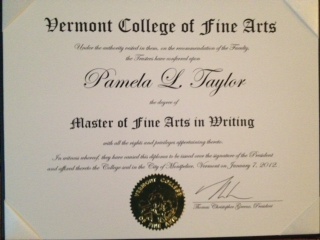
And what a wonderful reality it turned out to be! In two years, I completed four semesters of creative work and five residencies–– four in Montpelier and the inaugural winter residency in Puerto Rico in 2011. During that time I wrote and revised over 60 poems, wrote a critical thesis on the poetics of work, assembled a collection of poems as part of my creative thesis, “Oddball”, and presented a lecture that inspired this blog, “A Poet’s Double Life.” The program made me get serious about my poetry career. This dedicated time improved the quality of my poetry because I received individualized feedback on my work from a well-regarded poet. Participating in the residency workshops gave me the skills to read and critique poems. Having a personalized study plan exposed me to different poets, poetic styles, and issues of craft and helped me learn that reading is the number one way to bring issues of craft to life and inspire my own work. But what I cherish the most about the program are the lifelong connections with my fellow students, people who love poetry and writing as much as I do, and who as a group, are an indispensable part of my life as a poet.

If you’re thinking about a low-residency or traditional MFA program, you should definitely do your own research to find the program that is right for you. Poets and Writers magazine has ranked MFA programs in 2011 and 2012 and the Association of Writers & Writing Programs has a graduate program database.

Let me know your thoughts about low-residency MFA programs by leaving a comment.


4 Comments

Finding Inspiration


When I started writing, words poured out of me as if drawn up from some unknown emotional well deep inside. Poems flooded the pages, but it wasn’t until much later that I considered myself a poet instead a failed novelist. My emotional state directed the content of my writing: feelings of love, loss, and longing became the heart of the poems. Here’s an example:

I miss our magic

I miss the way your kisses taste like kisses are supposed to taste

I miss those four moles that form a constellation on your face

I miss the way you look at me and stare into my soul

I miss the easiness I feel when you take control

I miss you

Even though I’m not supposed to

Fast forward to Vermont College of Fine Art’s low-residency MFA program. For two years, I wrote 3-6 poems every month. I didn’t have the luxury to wait for the Muse to rifle through all the emotional boxes in the attic. I had to take inspiration wherever I could find it, even from the view of the old location of Chapel Hill Public Library:

Here is where I connect

to the essence of everything unfolding.

Here is where I witness

how life stripped down can be just as full.

But I already see buds forming on the leaning maple.

Soon an abundance of green will block the view outside.

(excerpt from Pritchard Park)

Now everything I see, touch, taste, hear, or smell can inspire a poem. The poems I wrote at Cave Canem ran the gamut of topics: my brother, my father’s death, unrequited office romance, professional development, berry picking, and the transit of Venus. Lately, I’ve inspired by photographs and movies like this one:

You were loose once

and then a mysterious

finger twirled you

around itself. You begged

for the ride to stop

and when it did, the middle

and thumb used you to strum

their pain. And now the ring

finger pulls you ever so

gently to your edge.

Fearing you will snap

at any moment, you beg

for the all-powerful hand

to release you and scream

when you reach your limit.

But then the pinky

hooks and stretches you

just a little more,

just to prove you wrong.

Images are a good starting point for expressing an idea connected to something I have observed or experienced. It is my job to find the words to let you, the reader, see this snippet of the world through my eyes.