A Poet's Double Life

For poets working outside the literary world.


2 Comments

Ekphrastic Poetry


For me, art is a constant source of inspiration. I walk through museums and galleries with a petite notebook and matching pen in my back pocket to catch whatever comes to mind. When I look at a work of art—be it a painting, photography, sculpture, or mixed media—I try to imagine myself inside the piece, either as the subject or the person observing the scene. For example, here’s what I wrote in response to this photo of fireworks:

Spark

Photo by Katia Singletary Art and Photography

One hand gropes
in the dark
and finds its match.
Now fingers intertwine
like stacked wood
transferring heat
from pressed palms
to wrapped arms,
pulling closer
and closer.
Then lips touch
and the miracle
of fire burns slow
through hips and toes.
Embers of shared
breath rise until reds,
purples, and golds bloom
and burst into fiery
chrysanthemums.

I like photography because a photo is literally a snapshot of a moment, which goes along with the narrative elements of the poems I write. Former North Carolina Poet Laureate, Cathy Smith Bowers calls this, “shining a light on a moment in time.”
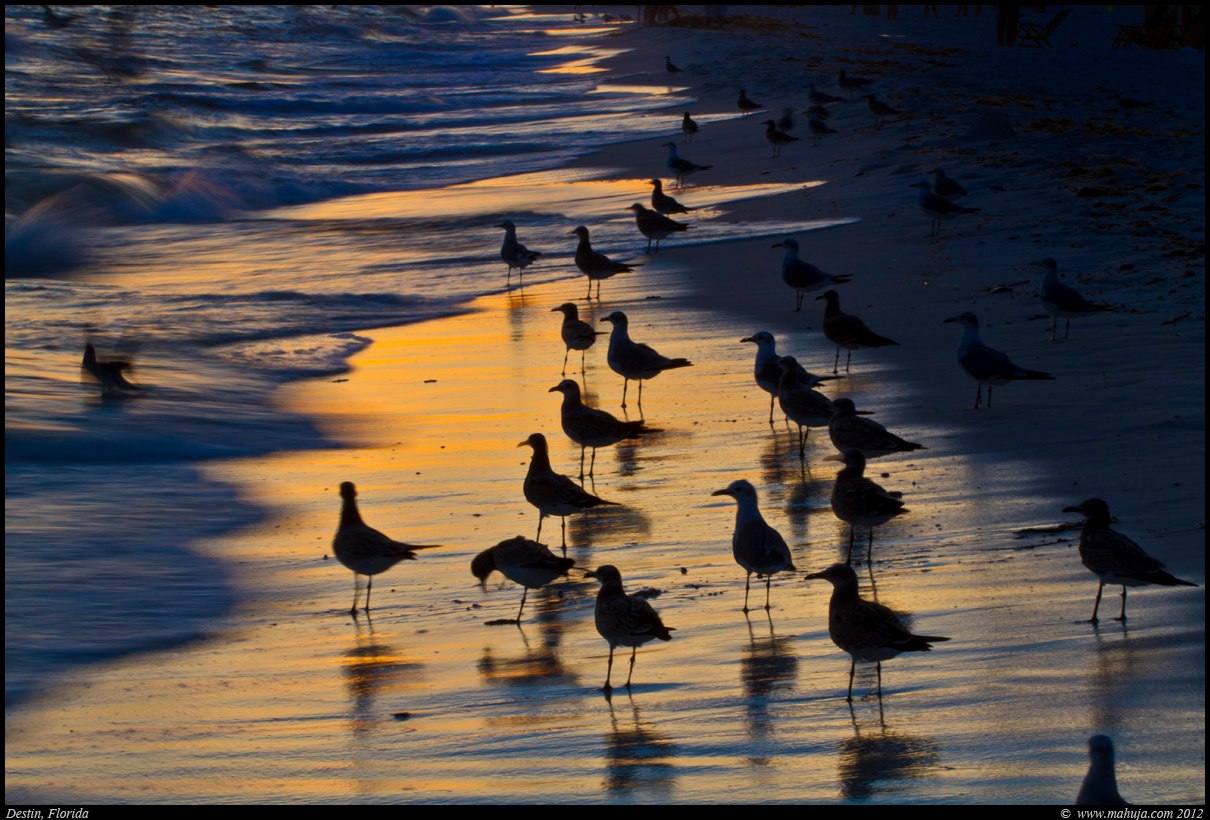
Photo by Manish Ahuja

As a poet, I have complete freedom to choose which moment to feature. The unseen creatures are the focus of this haiku:

The receding tide
leaves sand crabs bare on the shore
Raucous seagulls snack

A good ekphrastic poem should be able to stand by itself—without the requiring artwork to provide the context. At the same time, the poem should complement the artwork, enhance the meaning of the scene beyond what you can experience just by looking at it. Here’s a poem inspired by the well-known painting, The Sleeping Gypsy (read the poem and then visit the painting).

The Sleeping Gypsy

And now she sleeps—
stretched—with her water jug
nearby and the moon standing
guard overhead. I’ve stalked her
wandering scent in the desert heat,
beheld her bedazzling garments
as if a rainbow wrapped its arms
around her dark beauty. The mandolin
silent, but still singing her deep
alto into my jaws, my paws. I long
to be that instrument—what she wants
near, what her arms can hold.

Special thanks to photographers, Manish Ahuja and Katia Singletary, for granting permission to use their work.


Leave a comment

One More Open Mic


Living Poetry is jumping into the Triangle area open mic scene with an Open Mic Workshop at Straw Valley Café. You might remember this is one of my favorite places to write—and now, it will be one of my favorite places to read.

The idea came out of poetrySpark’s Best of the Open Mic contest. Most of the poets had a good stage presence and delivered their poems in the allotted time, but there was one contestant who must have read the longest poem she had ever written. She went well beyond 5 minutes—more than doubled it in fact—and flipped the page not once, but twice during her stage time. This poet went so long, I had time to go to the bathroom and come back to my seat before she even finished. Needless to say, she didn’t win the contest.

If you’re a “page poet,” getting up to read in front of an audience may feel like torture. I know many good poets who rarely give public readings. In fact, the Featured Reader event was the first time three of the six poets selected by the judges had read their poems in front of an audience.  If you are not an experienced reader, here are a few things to keep in mind:

  1. Pick a poem with audience appeal: That poem about your root canal may not be as interesting to others as it is to you (unless it is hilarious). Believe it or not, an open mic is a form of entertainment. People attend because they enjoy hearing poetry. Sometimes a poem that reads well on the page doesn’t translate well to the ear. That doesn’t mean you have to read fluff or avoid tear-jerker poems. Just be aware of which poems resonate with others.
  2. Know your poem: Read your poem before you step up to the microphone. Read it again. And then when you’re done—read it one more time. This step is particularly important if you are debuting a poem to see how people respond. You don’t have to memorize it (though the audience will be thoroughly impressed if you do), but the poem should be familiar enough so you can read it without stumbling over the words.
  3. Time your reading: Most open mic events have a time limit for each poet to read. Five minutes is enough time to read 2-3 poems (up to 25 lines each) and give the audience a little backstory for each poem. Having a good sense of how long your reading will take should help you feel more relaxed when you are on stage.
  4. Perform your poem (a little): Try to match your delivery to the poem. Be animated in your voice and use hand gestures if the poem is funny or lively. Be subdued if the poem deals with a difficult situation. Always, it is important for you to speak clearly and enunciate each word. The ear is not as forgiving as the eye and needs a little more time to process. Also, pay attention to your own punctuation—use commas, periods, and stanza breaks to pause, make eye contact, and of course, breathe.

Hopefully, you will overcome your fears of reading in public and join us for this event. If you don’t make it tonight, there are other open mic events on the horizon.


4 Comments

Chair Emeritus: Wallace Stevens


Wallace Stevens (October 2, 1879 – August 2, 1955) failed at his attempts to become a writer, and then a lawyer, and ended up working for an insurance company in New York. In 1916, he relocated to Hartford, Connecticut and joined the Hartford Accident and Life Indemnity Company where he stayed until the end of his career. Throughout those 39 years at The Hartford, Stevens published nine poetry collections, including Collected Poems, which won the Pulitzer Prize in Poetry in 1955.

Wallace Stevens tried to maintain a definite line between poetry and business. He composed many poems on long walks, and then, arriving at the office at 8:15 AM, gave them to his secretary, Miss Flynn, to type. Other than Miss Flynn, very few of his colleagues at The Hartford knew of his poetic endeavors and his success outside of surety bonds claims. Stevens equally protective his non-literary career, turning down Harvard’s invitation to serve as the Charles Eliot Norton Professor of Poetry, partly because he feared it would force his retirement from Hartford. Although he liked to keep his lives separate, Stevens felt:

“It gives a man character as a poet to have a daily contact with a job. I doubt whether I’ve lost a thing by leading an exceedingly regular and disciplined life.”

Of all the double life poets I’ve discovered, I’ve always felt my life most resembles Wallace Stevens. He achieved great success and respect in his non-literary career as an expert in surety bonds. Although Stevens did not write about work, his poems were influenced by his business trips to Key West:

She sang beyond the genius of the sea

The water never formed to mind or voice,

Like a body wholly body, fluttering

Its empty sleeves

The demands of a full-time job no doubt diminished the amount of poetry he produced, and his comfortable lifestyle probably put less pressure on him to continuously publish—and yet, he didn’t let work get in the way of pursuing his passion for poetry. If Wally managed to live the double life, then so can I.

Chair Emeritus is a monthly feature highlighting famous poets who have lived or are living the double life.


3 Comments

Three Minute Poet


A few weeks ago, I ran into Jan Parker sitting at a crowded bar right before the Erotic Poetry and Burlesque show started. After exchanging the usual long time no sees and you’re looking mighty fine tonights, Jan cut to the chase and asked the question I dread the most, “Are you writing?” Most people ask how is my writing, and I can satisfy their curiosity with a simple, “Fine.” If pressed for more specifics, I can always rattle off my litany of poem ideas to fend them off. But this was another writer asking me the question, and more importantly, Jan Parker, who has a finely tuned BS meter. So I told her the awful truth, “No, not really,” then gave her the run-down of my September–poetrySpark (of course) and the weeks of planning before the event, the upcoming football trip to Charlotte, and the wraparound weekend in Myrtle Beach with mom and then to Atlanta for a professional conference. And I did not fail to mention my day job and the 8 projects pulling me in exactly that many directions.

Jan held up a finger then dismissed my excuses with the shake of her salt and pepper mid-length bob, “You only need three minutes a day.”

“Three minutes?” I repeated incredulously. Three minutes is about how long it takes to write a poem on demand. Even I could do that. And maybe that would make me feel less guilty about not finding the 15 minutes in my day to write (as a former MFA advisor once suggested) or being able to get up earlier than the crack of dawn like Mary Oliver.

In the interest of full disclosure, I have not written for three minutes every day, but there has been at least one time each week when I’ve found time to put pen to page. Here are a few good lines:

September 18th: We used to believe that pluck and determination could shatter glass faster than our silent screams of protest

September 24th: The hall is dark, save a strip of light on the floor. When my eyes focus, my ears hear the music of laughter and clinking glass

September 29th: The ocean talks in his sleep at night in rhythmic murmurs

I’ve even used the three minute time to write poems in response to the Monday Poetry Prompt I send out each week to the Living Poetry Meetup Group

Visual prompt (9/24): From here the earth looks like the globe on your father’s mantle–perfectly round and unmovable

Borrowed lines (10/1): And the kiss that drained all of the bitter cynic from my blood


These poems and lines are not “finished”, but the three-minutes-a-day mantra keeps the creative juices flowing and helps to maintain the proper balance in the double life.


3 Comments

A Few of My Favorite Work Poems


My last post featured a recently published poem about real-life work experience. As a double-life poet I often am influenced by what I hear, see, and feel during the work day. At times I am able to lend a poetic voice to the white collar bureaucratic office environment that occupies 8+ hour chunks of my weekdays. However, there are times when what I write about work just sounds like I’m  venting without really elevating  the topic to the universal. When I have trouble finding the poetic in the mundane, I turn to some of my favorite work poems to inspire me.

Philip Levine “What Work Is“: Levine’s award-winning collection of the same name pays homage to factory workers. The title poem is the quintessential work poem about the loneliness and powerlessness felt by a day laborer that just expands to include the unspoken love for his brother.

“How long has it been since you told him
you loved him, held his wide shoulders,
opened your eyes wide and said those words,
and maybe kissed his cheek?”

Where much of Levine’s work poems focus on blue collar stiffs, poems in the collection, For a Living: Poetry of Work, features poems about white collar jobs. Two of my favorite poems in this anthology are Denis Johnson’s sonnet “White, White Collars

“We work in this building and we are hideous
in the fluorescent light, you know our clothes
woke up this morning and swallowed us like jewels,
and ride up and down the elevators, filled with us”

and Wanda Coleman’s lament about life as a medical billing clerk, “Drone

“i am a clerk
i am a medical billing clerk
i sit her all day and type
the same type of things all day long
insurance claim forms
for people who suffer chronic renal failure”

Lastly, Jan Beatty’s “My Father Teaches Me to Dream.” The final lines say it all.

“There’s no handouts in this life.
All this other stuff you’re looking for—
it ain’t there.
Work is work”

Ok I realize most of these poems don’t portray work in the best light, so I promise I’ll post some feel good work poems soon. If you know of any, feel free to leave a comment!


4 Comments

Publication Update


Good news!  All that effort to submit to literary magazines has yielded one acceptance, Mused: BellaOnline Literary Review. A few of my poet-friends in the Triangle have published there, so I thought I would give this mag a try.

The poem, “Professional Disagreement,” is one of my work-related poems and is based on a heated exchange I witnessed during a public meeting. The real argument was not pretty to watch and my boss’ description of what we saw and heard became the last two lines:

 “it´s just two country gals / throwing rocks with their tongues”

I wrote this poem during the April 2012 Poem-A-Day Challenge in response to the prompt, “communication.” You can read the poem here: http://www.bellaonline.com/review/issues/fall2012/p033.html


Leave a comment

Chair Emeritus: William Carlos Williams


William Carlos Williams (September 17, 1883 – March 4, 1963) was a pediatrician and general practitioner who worked out of his home on 9 Ridge Road in Rutherford, New Jersey. Williams knew from very early on that he would have to support his love for writing with another career. In his autobiography he writes:

“First, no one was ever going to be in a position to tell me what to write, and you can say that again. No one, and I meant no one (for money) was ever (never) going to tell me how or what I was going to write. That was number one. Therefore I wasn’t going to make any money by writing. Therefore I had to have a means to support myself while I was learning.”

Williams pursued medicine and poetry with equal dedication and commitment and often times simultaneously, for example stopping by his poet friends’ apartments in New York City after long days of advanced graduate training at pediatric clinics. Known for writing poems on the back of prescription pads, Williams felt being a doctor and a poet were “two parts of a whole, that is not two jobs at all, that one rests the man when the other fatigues him.”

Happy 129th Birthday, WCW!

Chair Emeritus is a monthly feature highlighting famous poets who have or are living the double life.


3 Comments

poetrySpark Weekend


After two months of planning, poetrySpark weekend is finally here! Here’s the run down of the schedule:

Thursday, September 13th

Living Poetry Organizers get their 17 minutes of fame during the Opening Ceremony @ Raleigh Amphitheater (7ish PM)

Spark After Dark hosts Erotic Poetry with burlesque dancers @ Kings Barcade (11 PM – 1 AM)

Friday, September 14th

Best of the Open Mic @ White Collar Crime (8PM – 10:30 PM) – Winner gets a Kindle Fire!

Saturday, September 15th

Poetry on Demand @ bazaar Spark in City Plaza (12 PM – 7 PM)

Youth Poets @ Morning Times Café (2PM – 4 PM)

Featured Readers Night has the six winners of the poetry contest + Sacrificial Poets, Terri Kirby Erickson, & Jaki Shelton Green @ The Union/Junction Salon (7:30 PM – 10 PM)

Sunday, September 16th

Poetry on Demand @ bazaar Spark in City Plaza (12 PM – 4PM)

Storytellers @ the Poetry on Demand Booth (3PM – 4 PM)

Hope to see you there!


5 Comments

The Poems I Need to Write


Lately, I haven’t been writing much because the double life is working overtime. My daytime career is chock full of project meetings and deadlines. My evening career is tying up loose ends with preparations for poetrySpark next weekend. Most nights, I collapse on the couch and veg out in front of the TV, often falling asleep before I realize it. And I feel guilty about it. Don’t real poets write at every possible moment? If Mary Oliver could get up at 5 and write for a couple of hours, isn’t that what I should be doing?

Instead of being so hard on myself, I am trying a different tactic—writing poem ideas down. Often the topics come in the form of working titles and a line or two that might be in the poem. Here’s my list so far:

Suiting Up: “If I don’t belong, at least I can dress the part”
Natural Hair: “Yes, natural hair is making a comeback everywhere—except my mother’s house”
Cleaning up the Break Room: “She wipes away the crumbs so they won’t think we’ve left a mess behind”

Then there are the planetary poems about I need to write to go along with the “Transit of Venus” poem I wrote during Cave Canem:

Mercury in Retrograde
Curiosity of Mars
House of Saturn

And the science-based poems that with any luck will turn into extended metaphors about race:

Dark energy/dark matter inspired by Adler Planetarium in Chicago.
Dark spot corrector inspired by a casual conversation with one of the inventors

I might have a trio of “Stuff White People Like” poems if I can ever finish that poem about yoga (#15) and start that poem on grammar (#99)

And just yesterday, I got the idea to write persona poems about famous women in technology

Lady Ada Lovelace – 1st programmer and daughter of Lord Byron
Grace Murray Hopper – found the first “bug”
Patricia Selinger – creator of stored procedures

Whenever I do get time to write, this list will keep me plenty busy!