A Poet's Double Life

For poets working outside the literary world.


4 Comments

When Life Happens


It’s been almost two weeks since I’ve posted on the blog, two weeks since Hurricane Sandy devastated the part of New York City where I grew up – The Rockaway Peninsula. Like many others in the Rockaways, my family did not evacuate this time. Last year they took shelter in Brooklyn after heeding the warnings about Hurricane Irene, who didn’t do much damage to the boroughs, opting to spread her flooding elsewhere. But as we all know now, Sandy was no Irene.

After waiting it out for 5 days and hoping the electricity and heat would return, my family found a hotel in Manhattan to spend the first weekend—a welcome respite from the disorder and cold. But as the Sunday checkout was approaching, the worry about where they would go to be safe and warm returned. By Tuesday things were settled, my mother and sister had voted, and they found a place to say in Brooklyn for the immediate future.
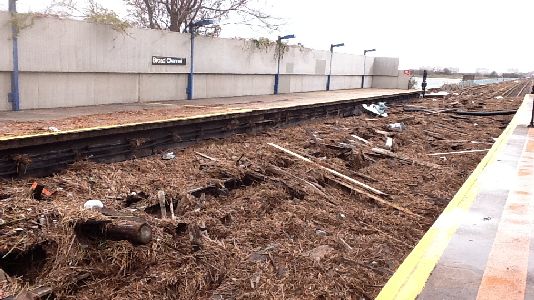
The situation in the Rockaways is still this: no power, no heat, no subway service. And by the look of this photo of the Broad Channel station—the stop that connects the Rockaways to the rest of Queens—it doesn’t look like the situation will change any time soon.

I couldn’t do much from North Carolina, but I did manage to check my mother’s AOL account and respond to the people who were concerned about her. I kept my phone beside me at all times in case someone managed to send out a text update before battery life expired. I followed Bob Hardt’s blog on NY1.com, an account of the Rockaway’s slow recovery.

In the midst of this I did write poetry—started the November Poem a Day challenge in fact—but that was all the writing my mind could handle. This week at work, I started writing sections of a report, which forced my brain to fire up neurons in Broca’s and Wernicke’s areas, and started me thinking I needed to get back to this blog.  So here I am!


4 Comments

Chair Emeritus: Wallace Stevens


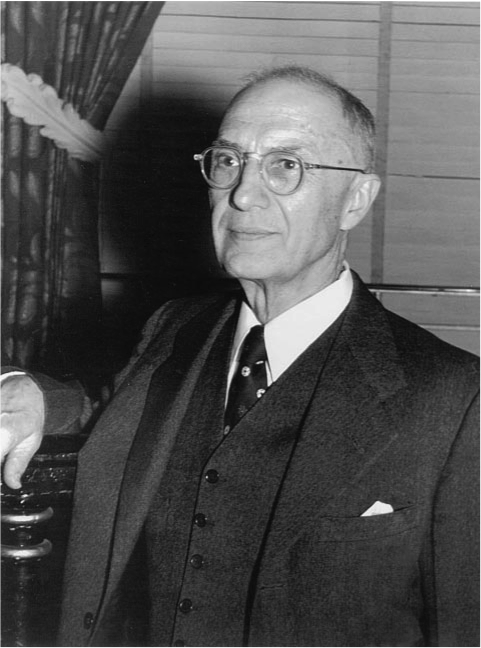
Wallace Stevens (October 2, 1879 – August 2, 1955) failed at his attempts to become a writer, and then a lawyer, and ended up working for an insurance company in New York. In 1916, he relocated to Hartford, Connecticut and joined the Hartford Accident and Life Indemnity Company where he stayed until the end of his career. Throughout those 39 years at The Hartford, Stevens published nine poetry collections, including Collected Poems, which won the Pulitzer Prize in Poetry in 1955.

Wallace Stevens tried to maintain a definite line between poetry and business. He composed many poems on long walks, and then, arriving at the office at 8:15 AM, gave them to his secretary, Miss Flynn, to type. Other than Miss Flynn, very few of his colleagues at The Hartford knew of his poetic endeavors and his success outside of surety bonds claims. Stevens equally protective his non-literary career, turning down Harvard’s invitation to serve as the Charles Eliot Norton Professor of Poetry, partly because he feared it would force his retirement from Hartford. Although he liked to keep his lives separate, Stevens felt:

“It gives a man character as a poet to have a daily contact with a job. I doubt whether I’ve lost a thing by leading an exceedingly regular and disciplined life.”

Of all the double life poets I’ve discovered, I’ve always felt my life most resembles Wallace Stevens. He achieved great success and respect in his non-literary career as an expert in surety bonds. Although Stevens did not write about work, his poems were influenced by his business trips to Key West:

She sang beyond the genius of the sea

The water never formed to mind or voice,

Like a body wholly body, fluttering

Its empty sleeves

The demands of a full-time job no doubt diminished the amount of poetry he produced, and his comfortable lifestyle probably put less pressure on him to continuously publish—and yet, he didn’t let work get in the way of pursuing his passion for poetry. If Wally managed to live the double life, then so can I.

Chair Emeritus is a monthly feature highlighting famous poets who have lived or are living the double life.


3 Comments

Three Minute Poet


A few weeks ago, I ran into Jan Parker sitting at a crowded bar right before the Erotic Poetry and Burlesque show started. After exchanging the usual long time no sees and you’re looking mighty fine tonights, Jan cut to the chase and asked the question I dread the most, “Are you writing?” Most people ask how is my writing, and I can satisfy their curiosity with a simple, “Fine.” If pressed for more specifics, I can always rattle off my litany of poem ideas to fend them off. But this was another writer asking me the question, and more importantly, Jan Parker, who has a finely tuned BS meter. So I told her the awful truth, “No, not really,” then gave her the run-down of my September–poetrySpark (of course) and the weeks of planning before the event, the upcoming football trip to Charlotte, and the wraparound weekend in Myrtle Beach with mom and then to Atlanta for a professional conference. And I did not fail to mention my day job and the 8 projects pulling me in exactly that many directions.

Jan held up a finger then dismissed my excuses with the shake of her salt and pepper mid-length bob, “You only need three minutes a day.”

“Three minutes?” I repeated incredulously. Three minutes is about how long it takes to write a poem on demand. Even I could do that. And maybe that would make me feel less guilty about not finding the 15 minutes in my day to write (as a former MFA advisor once suggested) or being able to get up earlier than the crack of dawn like Mary Oliver.

In the interest of full disclosure, I have not written for three minutes every day, but there has been at least one time each week when I’ve found time to put pen to page. Here are a few good lines:

September 18th: We used to believe that pluck and determination could shatter glass faster than our silent screams of protest

September 24th: The hall is dark, save a strip of light on the floor. When my eyes focus, my ears hear the music of laughter and clinking glass

September 29th: The ocean talks in his sleep at night in rhythmic murmurs

I’ve even used the three minute time to write poems in response to the Monday Poetry Prompt I send out each week to the Living Poetry Meetup Group

Visual prompt (9/24): From here the earth looks like the globe on your father’s mantle–perfectly round and unmovable

Borrowed lines (10/1): And the kiss that drained all of the bitter cynic from my blood


These poems and lines are not “finished”, but the three-minutes-a-day mantra keeps the creative juices flowing and helps to maintain the proper balance in the double life.


Leave a comment

Chair Emeritus: William Carlos Williams


William Carlos Williams (September 17, 1883 – March 4, 1963) was a pediatrician and general practitioner who worked out of his home on 9 Ridge Road in Rutherford, New Jersey. Williams knew from very early on that he would have to support his love for writing with another career. In his autobiography he writes:

“First, no one was ever going to be in a position to tell me what to write, and you can say that again. No one, and I meant no one (for money) was ever (never) going to tell me how or what I was going to write. That was number one. Therefore I wasn’t going to make any money by writing. Therefore I had to have a means to support myself while I was learning.”

Williams pursued medicine and poetry with equal dedication and commitment and often times simultaneously, for example stopping by his poet friends’ apartments in New York City after long days of advanced graduate training at pediatric clinics. Known for writing poems on the back of prescription pads, Williams felt being a doctor and a poet were “two parts of a whole, that is not two jobs at all, that one rests the man when the other fatigues him.”

Happy 129th Birthday, WCW!

Chair Emeritus is a monthly feature highlighting famous poets who have or are living the double life.


4 Comments

Living the Double Life


“One of the saddest things is that the only thing that a man can do for eight hours a day, day after day, is work. You can’t eat eight hours a day, nor drink for eight hours a day nor make love for eight hours — all you can do for eight hours is work. Which is the reason why man makes himself and everybody else so miserable and unhappy.” ~ William Faulkner

Often I feel disconnected from other poets who teach for a living, are freelance writers, or who have a job where they work with words, language, books, or images all day. My job taxes my analytical mind. I spend a lot of time in meetings, in the field gathering evidence, or in front of my computer processing information and data to identify problems and generate ways to solve them. My colleagues know that I am a poet, and send me links to poetry contests and articles about poets they happen to come across. They are used to it, having spent two years creating workarounds for my two-week stints in Vermont in January and July. They know I am “poeting” when they see my closed office door during the lunch hour. But I don’t expect them to understand anything about sonnets and I don’t try to steer the break room conversation away from “So You Think You Can Dance.”

Most poets I meet are full-time poets. They recognize what I do as important, but clearly unrelated to anything literary. Some can recount the litany of odd jobs they’ve had while they were finding their way to their first book or teaching position. But most let their eyes glaze over; they don’t understand how I can do something other than poetry all day and call myself a poet. Unfortunately, these are the same people who are editing literary journal and magazines, and don’t seem to relate to the poems I write about life at the office. Thankfully, my poet-friends are sympathetic to the double life because many of them have to carve out time from work and family to continue to do what they love to do.

I started this blog to be a place for poets with non-literary careers. The people, who like me, have both feet firmly planted in their careers and the poetry world. We have to work hard to succeed on both fronts and don’t want to have to choose between them. As much as I would love to live on poetry alone, I truly appreciate having a job that gives me the freedom and flexibility to pursue poetry. I don’t have summers off and my job wouldn’t pay to send me to the AWP Conference as part of my professional development, but I can afford to pay for plane tickets to writer’s weekends. And the 9.16667 hours in vacation time I earn each month can be used however I want, even for another trip to Puerto Rico.

So on this Labor Day, I wanted to express my gratitude for my other career, the one that allows me to live the double life.


Leave a comment

Chair Emeritus: Wendell Berry


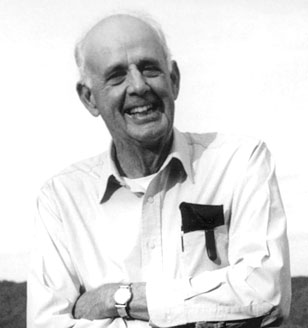
I couldn’t let the month go by without saying something about Wendell Berry, who turned 78 on August 5th. When I first got the idea to do my graduating lecture on poets with double lives, my adviser suggested that I ask around for recommendations of poets who have non-literary careers. Wendell Berry was the first name mentioned. And although he never responded to my kind letter asking him for an interview, I have the utmost respect for this farmer-activist-teacher-poet-essayist-novelist with over 40 works in fiction, nonfiction, and poetry.

Wendell Berry is truly his own man, living in Port Royal, Kentucky on land his family has farmed since the early 1800s. Berry is well-known for poems and stories featuring the Kentucky landscape as well as for shunning the Internet and email. His essay, “Why I Am Not Going to Buy a Computer,” is as much a protest against computers as it is a reminder that technology should make our lives better and not “replace or disrupt anything good that already exists, and this includes family and community relationships.” Even in his late 70s, Wendell Berry has been engaged in civil disobedience for causes important to him. He’s an old-school poet––not because he’s still writing long hand––but because he stands up for what he believes in and asks us to do the same:

When they want you to buy something
they will call you. When they want you
to die for profit they will let you know.
So, friends, every day do something
that won’t compute. Love the Lord.
Love the world. Work for nothing.
Take all that you have and be poor.
Love someone who does not deserve it.

~from “Manifesto: The Mad Farmer Liberation Front

Chair Emeritus is a monthly feature highlighting famous poets who have or are living the double life.


3 Comments

Poet in the City: Chicago


It’s been one of those weeks again! From Sunday to Thursday, I attended a professional conference on the non-literary side with over 3,000 attendees from every state and a few international observers. I arrived in Chicago on Sunday and took tons of pictures on the architectural boat tour, but didn’t feel comfortable downloading the images on my work laptop until now. (I like to keep the careers separate. It’s the Wallace Stevens in me). After the tour, I took myself out to dinner at P.J. Clarke’s while I waited for the 8:20 showing of Beasts of the Southern Wild. (Believe me, the cucumber martini looked as good as it tasted, and the potpie wasn’t bad either). Wednesday was the only other day I had time to see the city. I walked from McCormick Place to the Adler Planetarium along the Lake Shore trail. Two miles and 40 minutes later, I was happy to sit in a cool, dark room and veg out in front of the stars. Chicago is such an inspiring place.  No wonder Carl Sandburg wrote a whole poem about it!  In my next post, I’ll share a few of my own city-inspired poems.

This slideshow requires JavaScript.


Leave a comment

Chair Emeritus: Pablo Neruda


Pablo Neruda (July 12, 1904 – September 23, 1973) is the most widely read of the Spanish American poets. But did you know this Nobel Prize-winning poet worked for the Chilean government for much of his poetry career?  Neruda decided to apply for consular jobs after trying his hand at living on writing alone. Between 1927 and 1935, the government put him in charge of a number of honorary consular positions, which took him to Burma, Ceylon, Java, Singapore, Buenos Aires, Barcelona, and Madrid. As World War II threatened in 1939, Neruda was appointed to a special post in Paris for the immigration of Spanish refugees and secured the exodus of about 2,000 people to Chile.

Neruda’s poetic and professional accomplishments seemed to come in pairs. He was elected to the Chilean Senate in March 1945 and received Chile’s National Prize for Literature two months later. The very next year, Neruda served as the National Chief of Propaganda for Gabriel González Videl’s successful presidential campaign and legally changed his name from Ricardo Eliecer Neftalí Reyes Basoalto to his pen name. Neruda’s writing also created the conflict with the president that resulted in his impeachment from the senate and his eventual exile. Out of the political scene in Chile, he enjoyed recognition as a poet throughout the world. However, he continued to participate in the struggles of the Communist Party in Chile. Once the government was overthrown, Salvador Allende–the first democratically elected socialist head of state in Chile–appointed Neruda as Chile’s ambassador to France from 1970-1972, where he helped to renegotiate the billions of Chilean debt owed to European and American banks. He received the Nobel Prize for Literature in 1971.

It was a treat to discover that Pablo Neruda was a poet with a double life. We all know Neruda from his poetry. Who among us doesn’t have one of his love poems tucked away in the nightstand next to the bed. But throughout his life Pablo Neruda wrote and published his work, which just proves that all of us can find a way to walk down two different paths simultaneously.

For more information about Neruda’s life, please visit Fundación Neruda. To read a few of his poems, visit the Poetry Foundation.

Chair Emeritus is a monthly feature highlighting poets who have lived the double life.