In Autumn, While You Lay Dying
This poem has been published in the Fall 2013 Issue of When Women Waken (Theme: Grief).

In Autumn, While You Lay Dying
This poem has been published in the Fall 2013 Issue of When Women Waken (Theme: Grief).
Lessons in Commuting
Erzulie Dreams
Her heart sits below the waist
in an open drawer, boxed in
by nothing but air. Her useless
arms have fallen off–there’s no
curve in her hips, only bone.
With shut eyes and mouth, she dreams.
A coiled necklace quiets the screams.
~Pamela L. Taylor © 2013
~Inspired by a mixed media sculpture by Renée Stout in the Virginia Museum of Fine Art

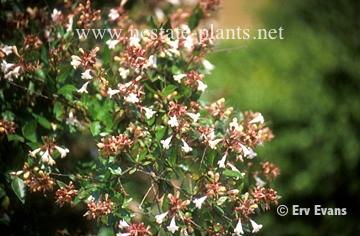
To Be Abelia
Like the shrub I bloom best in full
or partial sun and ample rain, surrounded
by buzz and flutter. But loveless years
have pruned back hopes, cut fairy-tale
dreams to the ground. What will grow
from this stub of myself? How much
longer before flowers return?
~Pamela L. Taylor © 2013
Inspired by “You’re an Abelia,” on Story Shucker.
Once again, I’m writing a poem a day in support of all the NaNoWriMo (National Novel Writing Month) writers in their challenge to produce 50,000 words in 30 days.
 Tree in Abscise
From the window, I watch you become
inflamed as if shamed by the sudden
rush of your own beauty. Not long ago you idled
in the heat of summer’s yawn, camouflaged
in tender verdure. I thought this was your true
nature, but now I see the way you draw the dew
within, shed what won’t last through winter.
~ Pamela L. Taylor © 2013
For three straight weeks, I’ve spent Sunday afternoons in a small office on the 4th floor of UNC Davis Library. I’m thankful for this space and for my generous German friend who keeps the key to his faculty study in a place where I can find it. This is why America should maintain the trust of our German allies.
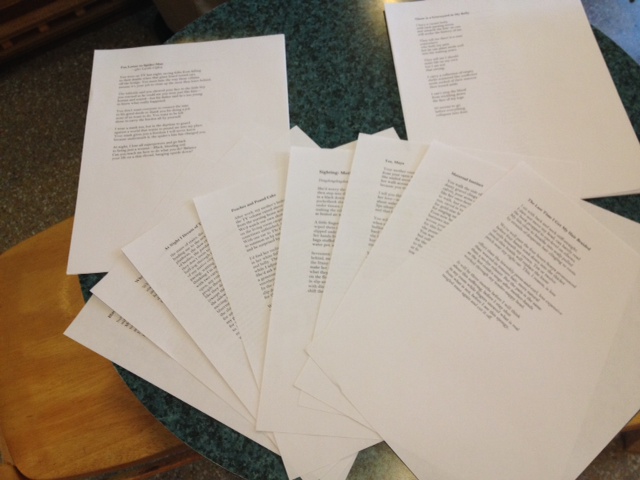
Typically, I spend about 5 or 6 hours there revising some poems, writing blog posts, researching literary magazines and book publishers or a little bit of all of the above. Yesterday’s goal was to assemble the 10-36 pages of poems that could possibly become a chapbook. Last week’s session whittled down the bulk of my writing to 43 pages, which completely covered the limited desk space. Then coffee arrived and chatting ensued, leaving the poems to talk amongst themselves.
Poems need this time to get to know each other, figure out how to arrange themselves, and decide whether to be part of the group. Forty-three pages became 27, including the four that called out to be revised in the middle of the process for a literary journal submission. Some of the poems in the Group of Twenty-Seven may not make the final cut. I see two distinct themes and about eight poems that bridge these ideas but are not wedded to either camp. And so the process continues.
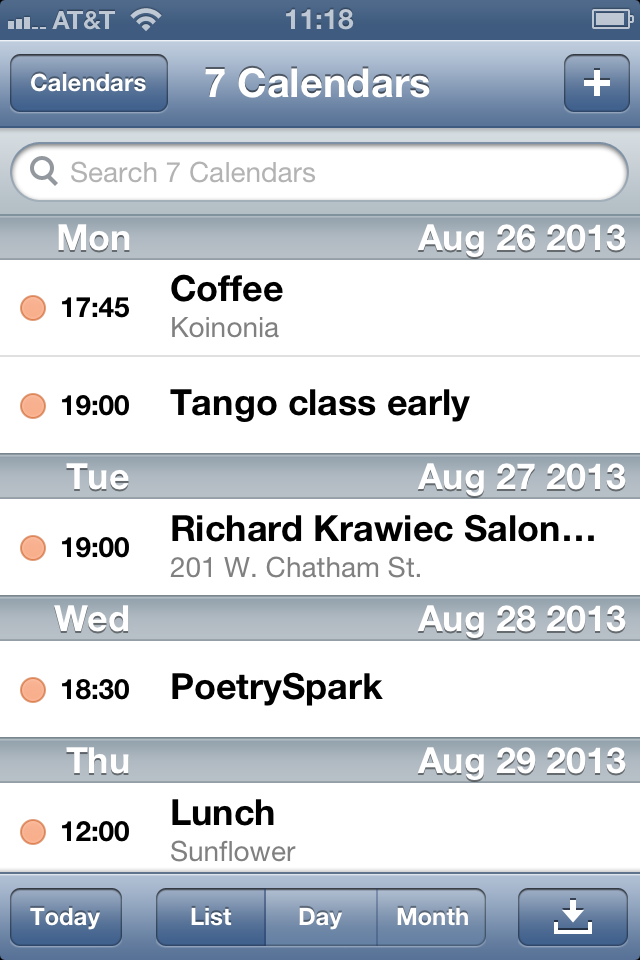 I hate to look at my schedule for the next few weeks but I can’t help it. I carry around a calendar in my head.
This week is packed–coffee meet followed by tango on Monday, practice session for a art salon on Tuesday, last poetrySpark organizer meeting on Wednesday, lunch meet on Thursday, and flying to California for the Labor Day weekend on Friday. Full days at work are the unmentioned yet unavoidable backdrop to the landscape of the upcoming week. September is no better–VCFA alumni gathering, a practice session for the art salon, a wedding, poetry book club, softball double-header (watching), poetrySpark, and a milonga–all before the 15th! And did mention the work project I am leading will be in the report writing phase and having to fly out to a professional conference in Austin, TX the morning after the art salon? And I know what you’re going to say, Pam, when are you going to have time to write, revise, and submit poems? I have no clue. September I will take a break from tango classes, though I don’t know if work or poetry expand to fill that void. We’ll have to wait and see.
You get in your car with the mini-tote bag from the Strand stuffed with your wallet, cosmetic everything bag, your poet’s notebook, and lunch —sesame salad, a Granny Smith apple, boiled eggs, and those addictive dark chocolate covered açai berry & pomegranate seed snack packs. You drive 25.7 miles from the heart of your urban life, passing a pasture of feeding cows, fields with odd-shaped and dilapidated houses, and a community store selling produce most likely picked down the road. Aside from the construction on Highway 86 that causes a patient backup of cars needing to continue down the only open lane, there isn’t much excitement in Cedar Grove—a perfect place for a one-day writing retreat.
Eleven writers wind their way down a gravel road on an old tobacco farm to get to the wooden cottage at the far edge of the property. For some, this time—9:30 AM to 4:00 PM on a Saturday—is the only time they have to dedicate to writing. You get three prompts to help you go where the writing takes you. And the writing takes you to the magical and the ordinary: grandfathers in spirit and vulture form, stuffed armadillos, the history that a hammock sees, a collection of boxes under a bed (not to be confused with clutter), your high school journal, your father’s journal, fancy dresses next to men in tuxes, inside the mind of teenager, and Botox.
You leave with a sense of accomplishment and community, and a strong desire to keep the writing going.

A research study of older adults in New Zealand demonstrated the power of writing in the healing process. The study assigned two groups to write about their lives. The first group was asked to write about a traumatic event, how they felt about it at the time, and to share thoughts and emotions they had never expressed. The second group wrote about their plans for the next day with no mentions of their feelings. The researchers took small biopsies of their skin and photographed the wounds to see how they were healing. After 11 days, the 76% of the people that hard written about their feelings had fully healed compared to only 42% in the other group.
This study completely fascinated me because it provided credible evidence of writing as a way to heal physical wounds. I know from personal experience that writing can heal emotional wounds. I started writing in late 2004, about a year after my father’s death in a car accident and the end of a 10-year relationship. Reading a book of poetry by Edna St Vincent Millay triggered the outpouring of emotions that I had kept to myself. Many studies have shown the benefits of writing for physical and emotional well-being. In fact, a recent article reported that Pierce Brosnan–Remington Steele and James Bond–is writing poetry to cope with the grief of his daughter’s death. However, writing about pain and grief doesn’t make you a poet; only when you aim to share that experience with others can your writing benefit the greater good. As James Baldwin once said, “your suffering means something only to the extent that people can attach their suffering to yours.”
In his craft talk at Cave Canem, Chris Abani posited, “all writing comes from an existential wound.” In his mind, wounds are not to be confused with suffering—to have a wound is not the same as being wounded. Abani believes that recognizing a wound is the key to opening up everything. The narrative of the wound becomes the story we’re telling—it is the driving force behind why we write. As poets, writing from a wounded place can bring more than self-healing. When our writing speaks from that existential wound, we can connect to others in a deeper way and be the catalyst for healing ourselves as well as our readers.
 One of my favorite bloggers, Patrick Ross at The Artist’s Road, reviewed the new book Creative You: Using Personality to Thrive by David Goldstein and Otto Kroeger. The book breaks down creativity across the sixteen personality profiles found in the Myers Briggs Type Indicator (MBTI). The MBTI personality profiles are a combination of four dimensions:
1) Direction of Energy: E(xtroversion) or I(ntroversion) – E’s prefer to attend primarily to the outer world of people and things, whereas I’s prefer the inner world of ideas and thoughts
2) Tools of Perception: S(ensing) or iN(tuition) – S’s are interested in applied and pragmatic endeavors whereas N’s prefer more abstract and theoretical endeavors.
3) Tools of Judgment: T(hinking) or F(eeling) – T’s are more interested in a technical-analytical approach to life and F’s are more interested in the communications-relationship aspects of life.
4) Lifestyles: J(udging) or P(erceiving) – J’s prefer a lifestyle that is more structured and decided and that allows them to bring closure to things, whereas P’s prefer a lifestyle that is more flexible and adaptable and that allows them to continue to gather new information
From the time I took my first battery of personality and career-interest assessments in college, my MBTI has been INTJ. These letters roll off my tongue as easily as my childhood home address. They are engrained in my brain like the product of 8×7 (56!) has been since 2nd grade. My boss is a certified MBTI consultant and gave us the assessment in February 2011, where I was once again, INTJ. Fast forward to June 2013–four new people at work and another opportunity to take the MBTI, where I was an INFJ. A what? When did I become a F?
I certainly blame poetry for the transition (seamless as it was). One of the major differences between T’s and Fs is this: T’s believe telling the whole truth is more important than being tactful and F’s believe being tactful is more important than telling the “cold” truth. As a poet, I certainly believe in the words of Emily Dickinson, “Tell all the truth but tell it slant.” Poets are more concerned with the big T universal truth and sometimes have to change the facts to reach that goal. I guess creative non-fiction writers like Patrick are INTJ’s because their work has to find that balance between the big T and the little T of truth.
Here are a few more insights about INFJ’s
Ok, so maybe the INFJ shoe fits. What’s your MBTI type?
The real MBTI cost $150 to take, but Personality Pathways offers a cognitive style inventory that approximates your MBTI preferences.
 A Poet's Double Life